

 Apple Podcasts
 Spotify
 YouTube
 iHeartRadio
 Amazon Music
 #068: When Wall Street Success Isn’t the Legacy You Want to Leave With Jing Herman
What happens when you realize the life you built… isn’t the life that will outlive you? For many creatives, the path is rarely straight. It bends toward practicality. Toward stability. Toward the careers that make sense on paper. In this episode, Maddox and Dwight sit down with artist Jing Herman to explore a journey that began in childhood creativity, moved through the high-pressure world of finance and strategy, and slowly circled back to art. Jing grew up in Beijing during the 1980s, in a ...
What happens when you realize the life you built… isn’t the life that will outlive you?
For many creatives, the path is rarely straight. It bends toward practicality. Toward stability. Toward the careers that make sense on paper.
In this episode, Maddox and Dwight sit down with artist Jing Herman to explore a journey that began in childhood creativity, moved through the high-pressure world of finance and strategy, and slowly circled back to art.
Jing grew up in Beijing during the 1980s, in a world very different from the one she lives in today. As a child, art came naturally. It wasn’t a career path or a calculated decision… it was simply part of who she was.
But like so many creatives, life eventually steered her toward more “rational” choices. Business school. Wall Street. High-performing professional environments where success could be measured clearly and rewarded generously.
Yet somewhere along the way, another question began to surface.
Not about success.
About legacy.
What actually remains after the work is done… after the promotions, the deals, the years spent building something that the world quickly moves past?
That question slowly led Jing back to the studio.
In this conversation, she shares the moment she began to reconsider what truly lasts, why creativity may be far more essential to human life than we’ve been taught to believe, and how identity plays a powerful role in the creative journey.
This episode is not about abandoning one life for another.
It’s about recognizing that creativity often waits patiently beneath the surface… sometimes for years… until we’re finally ready to listen again.
Along the way, the conversation explores creative identity, the role of reinvention, the quiet influence of family and upbringing, and the powerful role community plays in sustaining artists.
Because sometimes the most meaningful creative journey isn’t about becoming something new.
It’s about returning to who you were all along.
This is Maddox & Dwight! More than anything, we want to connect and communicate with you. We don't want to think of you as listeners. We want to think of you as community. So, scroll to the bottom of the show notes and click the SUBSCRIBE link. Thank you!
Thank you for listening to the For the Love of Creatives Podcast. If you are enjoying the podcast, please scroll to the bottom of the show notes and Rate & Review us. We would SO appreciate it.
Book a Discovery Call With Dwight
Become a SUBSCRIBER to Get Notified of New Episodes
Want to be a Featured Guest?
00:00 - Why Art Outlasts Careers
01:32 - Meet Jing Herman
02:03 - Growing Up Under Communism
05:17 - Claiming The Flag As Home
06:55 - Inventing A Non-Toxic Medium
12:43 - Archival Choices And Rivers Statement
24:38 - Becoming An Artist For Legacy
33:26 - Reinvention Without An Art Degree
46:00 - Community That Keeps Artists Going
54:13 - Walk, Visualise, Then Do
Why Art Outlasts Careers
SPEAKER_00Like crazy in tech, but like does anyone remember that? Like some tech startup. We even if we succeeded, like the it doesn't matter, like just m the world just moves on. But I think art stays the art that you leave behind, like really actually grows right in in importance over time, right? And is something that I can truly leave behind.
SPEAKER_02Welcome to another edition of the For the Love of Creatives podcast with your hosts Maddox and Dwight. Today we are joined by the lovely Jing Herman. Welcome to the podcast, Jing.
SPEAKER_01Hey, welcome, Jing.
SPEAKER_00Thank you so much for having me.
SPEAKER_02I would love for you to just share a little bit about who you are and your your story for listeners. Just uh, you know, one to two minutes to have some idea about uh your story.
Growing Up Under Communism
SPEAKER_00Yes, of course. I grew up in Beijing uh under communism in the 1980s when uh Raywan was the only child and there were millions of bicycles on the on the streets and no cars. Um I was very prolific with art when I was little. Um on the top of my website bio, you can see a photo of me at age six being surrounded with all of my art. Um and when I came to uh I came to New uh United States when I was 10, I went to NYU. And I remember it in college telling people that I peaked and plateaued at age five. And it actually took me a long time to think back and think, why did I even tell people that? And I think after in my 30s, after I had kids and um and and then later I started doing more art um after many years on Wall Street and in tech, I realized, you know, I I think at age five was when I was just doing art all day. And I was very proud of my art. And uh under communism, school is so grueling that like even in first grade, it had so much homework. You have to go to school on Saturdays and go to, you know, stay at school to five with hours of homework. Even after six, I had like a lot less time for art. And I think back and I think I told people that I peaked in plateau at age five because I was doing so much art and just being prolific and like innovating with my art. Um so that's a a quick story. And now currently I'm working on a series of American flags, apolitical, nonpartisan, meant to let people focus on the beauty of America in order to find a common ground and inspire unity.
SPEAKER_02That sounds beautiful. And and there's seems to be a part in the middle that a lot of people would probably be quite interested in. You you hinted at how there was something that happened on Wall Street, and I I read a little bit of that on your site. And uh it's kind of a unique experience. Like you're I uh just I'll just um relay the story as I remember it. You had one of those things that was kind of like a successful exit where you were set up with um life-changing money and you were having a celebratory dinner and everyone was saying what they were going to do, and you were the oddball that said that you were gonna make art. So, like you're living your dream, and this is this is amazing.
SPEAKER_00Yeah. Actually, so that situation was hypothetical. Like, if we had to exit, what would you do? Okay, so I it was a unicorn startup. Unfortunately, I didn't make life-changing money. But you know what, you don't need life-changing money to become artist, right? And that's what this podcast is all about, right? Like our journey. But yeah, I was the oddball in that, you know, everyone said everyone just, you know, in finance tend to stay in finance, people in tech tend to stay in tech. And people were shocked when I said, you know, if we had an IPO and we could do whatever we wanted, I'd be an artist, like 100%.
SPEAKER_01I love that.
SPEAKER_02Good on you.
SPEAKER_01Jing, I would love to know what was the inspiration that drew you to do the series of flags.
Inventing A Non-Toxic Medium
SPEAKER_00Good question. So I, you know, so I started with um my story being growing up under communism, right, in Beijing. And when I came, you know, life as an immigrant is really challenging, really hard. You know, I think um immigrants are like the the heroes that are like brave and come for a better life and more liberty. Um and when I I and I moved to Texas and I lived in Dallas for seven years, and there are flags everywhere, right? And it didn't feel like my flag yet, right? And then in 2007 was when I became a citizen, and I was working at Bear Stearns on Wall Street at the time, and my boss got a large American flag cake to celebrate, you know, my citizenship. And I think in that moment, first of all, I was so touched by his kindness, and in that moment I felt like, okay, now the flag is mine. Um, and I was saying how, you know, for years during finance and tech, I didn't have very much time to paint. I remember in uh around that same time, 2006, I actually took an entire vacation and I just stayed at my parents' house and I just painted the whole time. You know, instead of going out going to a beach or going to Europe, I felt like, okay, I I just I have so much, you know, built up. Like what I really need is a creative outlet. And my mom just made breakfast, lunch, and dinner, and all I did was paint for like 15, 16 hours a day. And that was an incredible vacation. Um and that brings me to um, you know, later when I had kids, we we just we kind of went through our whole house. And, you know, with with pregnancy, you tend to say, okay, I'm gonna stop eating sushi, stop drinking wine. And we started looking at what around the house is toxic. And and then I was shocked to learn that a lot of art materials are actually very toxic. Um, the cadmium and oil and acrylic um that gets absorbed absorbed through the skin. Um, so for about a decade, I didn't do very much art, um, just some with my kids because I felt like I felt discouraged that professional art materials has so many toxic things, and we kind of wanted to pursue like a healthy, eco-friendly, family-friendly um lifestyle. And the series was born when I started experimenting with different materials, and I realized if I mix non-toxic acrylic paint with Elmer's clear glue and adding Arminghammer baking soda, that it thickens, you know, it's like very satisfying, you know, process of almost like making batter. It it creates a thicker texture that through experimentation I can kind of control, you know, the ratios between the paint and the glue and the baking soda. And then the more baking soda, the thicker. And you can also add like, you know, sugar and other sand, other, you know, thickeners. Um and I think that just that changed everything. I realized, okay, I, you know, I don't have to be discouraged. I don't have to use only like, you know, thin temperature kids paint. I can actually achieve the same texture that professional artists use. Um and I saw online that there were other artists using like marble dust or you know, construction powder. Those I think are a little more toxic than just baking soda, which is kind of the, you know, you we eat baking soda, it's the safest possible thing. It doesn't really aerosolize. Um, and so when I created this new medium for myself, and I realized the thickness allows me to embed things, um, shells, coins, you know, any any anything and everything, sharp teeth, I'm working with gemstones. Um, it just, I'm I'm a creative person at heart. I think we are all, all humans are creative. It just really lit me up. You know, I think for a long time, not only was I feeling limited by the material, I wasn't being flooded with ideas of what I wanted to create. But after I did the first American flag with um sand dollars and shells and um starfish, I was just flooded with ideas of different ways to show a different aspect of America, tell a different story. Um, and I think I'm someone who's always pursued my ideas, you know. Like um, some people have said, like, treat your ideas as like a guest, a person, you know, when you meet when you meet them, like get to know them better. So I feel like I have to respect these ideas that have popped into my mind. And so now it's become a series of 50. I've only completed five. I have a whole pipeline that I'm working on, and um, hopefully commissions as well for families. Uh I've met families that are, you know, daughter of the American Revolution, or they were, you know, their family, you know, were active in like the Civil War, like they still have photos and old heirloom items that they want to embed. Um, companies that maybe are like all American companies that really value, you know, these American ideals. So I think hopefully I can paint maybe half of them with my own ideas and then half with through commissions.
SPEAKER_02That sounds wonderful. And what an what an amazing journey and project.
SPEAKER_00Yes, thank you.
SPEAKER_01A big project.
SPEAKER_00Yeah, and the series is called Beautiful Country, because in Chinese, America is translated Mei Gua, which means literally beautiful country.
SPEAKER_02Oh wow. Wow. That's really amazing. I I'm really impressed that you found a way to get back to the thing that you loved. You know, despite how there were some red lines with, you know, I think a lot of people would just give up and think, well, there's no way of of pursuing the art without uh exposing myself and my kids to serious toxins. So I guess that's it, but not you.
SPEAKER_00I think there's more, a little more awareness on that lately. Um there was uh recently we're uh my kids and I were listening to an audiobook, um, The Disappearing Spoon by Sam Keane, which is all about the periodic table. And that's where we we learned that um the reason why cadmium is so bad is because it's it's similar to calcium and your body mistakes it for calcium. So your body literally thinks that the calcium in the in the red tube of paint, um, the cadmium in the red tube of paint is calcium and it actually puts it in your bones. Um and unlike the food you eat that leaves your body within a day or two, the cadmium stays in your body, the half-life is like 10 to 35 years, which means it doesn't really leave your body and so it slowly accumulates.
SPEAKER_01Wow, that's kind of scary.
unknownYeah.
SPEAKER_01And I I've not researched this to any big degree, but when you buy products that say hue, that is something completely different, isn't it? Like if you bought red cadmium hue, the hue is where they've taken, figured out a way to mimic that cadmium without actually using cadmium. Is that correct?
Archival Choices And Rivers Statement
SPEAKER_00I'm not sure, but I actually want to let's dig into this more and then we can write a blog about it.
SPEAKER_02Cool.
SPEAKER_01Yeah. Yeah. So another question is coming up for me because I have yet to ever meet anybody that like literally created their own art products. And I'm wondering, was there any um research that you went through that would determine if your your in your ingredients in your recipe for your art products were going to enable them to be archival?
SPEAKER_00I think this is still work in progress. I've read done a lot of research that led me to this point. I think I will continue to um research more. Um and for example, the when I did this American Rivers one, firstly I didn't know there were so many rivers in America. I probably could have only named, you know, Rio Grande. I lived in Texas, Mississippi, maybe the Yukon. Um and actually I used, while I was researching, I used AI, and actually I had the idea of using Sharpie for the rivers. And AI said, you know, no, that's not a good idea because Sharpie is not archival grade. So that means over time it will turn brown. And I said, actually, that's perfect because part of this, you know, it's almost like living out my American dream being artists. It's a critical love letter to America. Part of it is also a critique, right? Like we've we've ruined our rivers, right? So the the Sharpie in this painting will actually turn brown in the next 50 to 100 years because it's not archival grade. And that actually makes a statement all to itself, right? That through industrialization, we've polluted our rivers. And I think each of the paintings, I would, I want them to tell their own story and have its own costs. So when I sell this one, I hope to find someone who's very aligned on uh protecting and cleaning up our rivers and lakes. And part of the profit will go toward, you know, working with an organization that would clean up the rivers and lakes.
SPEAKER_02I just want to call out to anyone that's watching the video of this on YouTube. It is very well researched. You you have captured all of the rivers and basins and gave a nice treatment to the Great Lakes. That's a that's a great work.
SPEAKER_00Thank you. Thank you. Yeah, and then there is a lot of history there as well, because I was start I started looking at different um posters of of, you know, and maps. And I started seeing some differences. I'm like, wait, wait a second. First of all, I I I'm not sure if what I'm looking at is accurate, if someone used AI or if it's an old map, or maybe old maps could be wrong. But apparently um it shows time and history because some rivers can be diverted, right? So I think it was the Red River going to Mississippi. It was diverted um a few decades ago. And so if you really do pay attention and study, it does actually tell history. And you can tell when a map what period it's from, based on, you know, whether the the rivers have been diverted or not.
SPEAKER_02That's amazing.
SPEAKER_01Your your whole process is very innovative. I mean, it's very out of the box and very unique. Um yeah, I I I love the fact that you you took something like, okay, the markers aren't archival and used them to your advantage. You know, the fact that they will turn brown instead of remaining the color that you painted them with.
SPEAKER_00Um, I also just a note on that, I wanted to I wanted to use Sharpie because I found a story about how they moved manufacturing um from Asia back to Tennessee, like 99% of it so far, and soon 100%. Um and I'm from China and I, of course, I I support, you know, Chinese products and I support globalization. But I think there what's not really known in America is like there are all these towns and cities and villages in China where everyone has cancer because the manufacturing is so toxic. You know, and I think it's really easy as Americans to buy products from China and not care like what's happening to the workers in China because you'll you'll never meet them. But when American companies move manufacturing back to your own city, your own neighborhood, you don't want to pollute your own children. You don't want to pollute your neighbors. You're much more responsible, I think, as a steward, right, of our nature and community. And you just think a little harder about, okay, if I have choices on what materials to use, if you if you care, then you would choose the less toxic one, you know? So I think by default, by bringing manufacturing back, and I was saying in the beginning, I really don't like, you know, talking about politics, this is all about unity. But this is all that my art is a a result of my health journey as well, right? Like if I didn't find a way to make these materials non toxic, I don't think I would have like found that. I would have had that light bulb moment. Um so because of that story, I wanted to use Sharpie um in this particular painting in order to highlight that story. And I think there, if there's more demand from Americans for non-toxic R materials or non-toxic products in general, you know, slowly I think people, companies in China will get the memo and they will say, okay, there's more demand for non-toxic things. Let's let's move in that direction. Let's, you know, make figure out how to make things more non-toxic. And over time, that will benefit everyone, the health of Americans as well as the health of Chinese workers.
SPEAKER_01We're we're definitely starting to see more product lines come on the line on the market that are non-toxic. They are insanely expensive. Like if you it's just like eating organic. You pay through the nose to eat organic vegetables rather than non-organic. And I don't know. I I don't I I I wonder about that sometimes. Is it really that much more expensive to make a non-toxic paint? Why is the price of this paint three times what the other paint is? I question that.
SPEAKER_00Yeah. Yeah, to your question about um how I'm looking at future materials, like I've I've kind of thought about this idea of packaging, you know, this modeling paste essentially that I'm making and selling it in a store. Um, and I think you have the same problem as food. Like the reason why a lot of food is is highly processed food for us is bad because of all the preservatives. And actually, the paint in the for the modeling paste for it to really have a long shelf life, you need almost like paint preservatives, right? Solvents and um emulsifiers to like keep the consistency. Because after I make this paste, after a day or two, I can see the separation, right? The materials are separating. Once it's painted, it's it seems like there's there's no change and it's it's in perfect condition a year later. But the paint that's unused, I see the separation. So um, so I've been thinking about this myself. If I want to launch, you know, workshops where people can get material sent to them. I I think I might send the acrylic and the glue and the baking soda separately. And, you know, the participants would have their own joy of learning to mix the texture and also learn to experiment um, you know, with like thicker or thinner, you know, to their own liking. And I think it's very accessible because it's very similar to to baking, you know, when you have to make the different batters and and follow a recipe. So I hope it'll it'll catch on, you know, like you know your calories instead of eating them.
SPEAKER_01That's that's interesting because I you know, I I I I'm fairly new to the all this, and but I'm I'm watching how, you know, with maybe two shades of red, two shades of yellow, and two shades of um red, yellow, and blue. Red, yellow, and blue. That's the three primary curls. You can mix any color. And yet you go into an art store and most of the lines have every possible shade in a bottle, and that's because we are so convenience-oriented. I've I have really spent time trying to learn how to mix my own colors. It's a hassle, but there's something really gratifying about it. But I just wonder there's a reason that there's so many colors available. And I I think that just and and I don't know if that's a thing here in the US or whether that's a thing everywhere. We are very convenience-oriented and we are very comfort-oriented. And I would think that would play a role in it as well.
SPEAKER_02Well, I I suspect that there's an element of what it is to be an artist, to be someone that's a maker. There's a desire to really get involved in the process. And I can see how you're gonna trade convenience for really getting into what it is that you're you're making, really understanding it and inhabiting it. And I I could see how someone would really want to dive in and learn as much as they could about the recipes. And I I'd say the the capstone event would be if they were able to innovate, you know, add their own little twist, add a little uh add some sparkles to the mix.
SPEAKER_01I like the mixing. I like the chemistry aspect of it. I don't know if I'm the exception or the rule. Um I have I have a history. I was a hairdresser for 40 years and had to learn advanced um formulas. For hair color. And of course, it's very different with art, but the basic theory is in there. You know, you mix two or three things to get together to get something new that's not otherwise available. And there's something that's very exciting about that, especially when you actually say, Oh, I'm going to make a very specific shade of green, and boom, you do it. There's something very gratifying about that. It's like a signature shade.
SPEAKER_00Yeah, I think my favorite thing from art was always just mixing the colors because it's very like flow state. You know, in my um during the pandemic, in my like previous role, I had um, I was a co-founder of a small business called 20 Amuses, where we did virtual team buildings during the pandemic. Um, a lot of people were doing art, which was amazing. And uh we were, I think our goal was to help people connect with creativity, especially those who are not creative, like lawyers, accountants, you know, people who said, I've, you know, I'm not an artist. That's not my thing. Or I was always bad at drawing, I was always bad in art class. Um, those were the people that we wanted to reach the most. Um, but the brain science around art and like mixing colors and painting, it's it's just it's like the best thing for your brain. You know, it's the antidote for the burnout, you know, instead of like scrolling like on social media, which basically overstimulates your brain, and there's like, you know, too much going on every two seconds, you're changing, like seeing something else changing your thought. The flow state of like just taking your time to mix and paint, it do to do that for 10, 20, 30 minutes, you get all the dopamine and and endorphins like in a healthy way.
SPEAKER_01It's incredibly soothing, isn't it?
SPEAKER_00Yes, exactly. Because your brain falls into this like relaxing flow state.
SPEAKER_01So I'm gonna shift gears for a minute because I I'm thinking about something I want to ask about. You talked about, you know, being under communism as a child and how harsh school was, and how much time you spent at school and how much homework you had, and that pretty much ripped you away from your art, from the art world pretty much altogether. And and then there was the point where you ended up, you know, on Wall Street and in a pretty powerhouse job, which probably consumed a lot of time and energy where there wasn't so much time or energy for art. You have found your way back to art. And on this podcast, we have a pretty fair amount of conversation about becoming, because we believe as a creative, you're always becoming something new, a new version of yourself, always changing, always growing. And I'm I'm curious if you can articulate, you know, what who you had to become, you know, that internal thing when you had been ripped away from your art for so long and it was a distant memory almost, and you found your way back. Who did you have to become in here to make that transition and and come back and be yet again immersed in in the world of art, your first love?
SPEAKER_00In in college, I had a really memorable moment um when we were sitting around and talking about um someone asked, you know, what why is Madonna so successful? And um and someone else said, Madonna is successful because she keeps reinventing herself. And um this was the year 2000. And I remember I was 18 and I remember being like, okay, I need to write that down in my mind and never forget that. Um and I think that's that's the key that really I think all humans are meant to be artists, like especially now that there's so much AI. I feel like in our core, everyone is a creative, everyone is an artist, but we make very rational decisions on career. Well, first of all, like the college and what to major in and what job to get, you know, based on, you know, you want to buy this house, you have to make this much money. I'm the daughter of a mathematician. Um, and you know, going on Wall Street to me was just a very rational decision. But really, I think all of us are meant, really meant to be artists. I think that's what's good for our brain, that's what's good for our like health and and and lifestyle. How I found my way back, you know, like I I've told you this story, but I I think in my in myself, and it comes with age, I guess. I think I feel like after I turned 40, I was more thinking about like what legacy do I want to leave? You know, and I felt like, yes, I worked 100 hours a week on Wall Street, investment banking and strategy, but does anyone remember any of that work? No. You know?
SPEAKER_01Like not much of that.
SPEAKER_00And then I worked in like crazy in tech, but like, does anyone remember that? Like some tech startup. We even if we succeeded, like the it doesn't matter, like it just m the world just moves on. But I think art stays, the art that you leave behind, like really actually grows right in in importance over time, right? And it's something that I can truly leave behind. Um, so I think back to that moment of when I was five and and say myself saying that I have peaked in plateau at five, realizing that I think two things. One, I my identity was so strong because I was making art. And then two, I think that's when my parents really like invested in me and like took me to all these art classes and and spent time with me. Um, I think those two combined gave me such a strong identity. Um, now I homeschool my kids. I try, you know, I try to spend a lot of time with them because my as an immigrant, my parents had to work 24-7. I was home alone all the time. Um, and I think this is what I want to leave behind. You know, some people make a lot of money in finance and they put their name on a building and that's their legacy. Most people can't achieve that, and nor do most people, I think, derive meaning from that. But I think the work that we make with our hands, it doesn't matter. And what I'm realizing with art now is it doesn't matter what the art looks like. It's more about your heart, right? Like the how it looks, everyone is is is our subjective. Everyone sees something else. So it doesn't what it what the art looks like will mean one thing to one person and something totally different to someone else, but it's all about what it means to you and why you made it. Um, and I think in my in my inner core, I think I just got to a place where I felt like, you know, the little time that I have, the most useful time that I could do with my little time that I have left after being a mom and homeschooling is to make art. And that's the most important legacy that I can leave behind, not just like leave some for my for my kids, but hopefully it will hopefully one day it will be collected and sought after in collections and museums and institutions. Um and it's also I think an impact that we can make on the world, right? Hopefully, my art can be, you know, a tool for conversation to bring about unity, you know, for that 250th.
SPEAKER_02And what better legacy can you you hope to have than to have made your mark in your art?
SPEAKER_01You know, um there's something I'm hearing that you're not saying. You tell me if if this is anywhere close to being accurate. The whole becoming question. I I'm hearing you say that you had to become a person who stepped back and re-evaluated your core values. Because sometimes we lose track of our core values. You had to re- not necessarily re-evaluate or changed, you had to re-acquaint and establish a relationship with your core values. Is that correct?
SPEAKER_00I think so. Yeah, I think so. And I I had I had uh I think last year I randomly remember that even in college, even though I was in business school and all my classes were business classes, um, what my final essay was on the business of art. You know, I think my whole life had been pointing to this, to this moment. And I think we have to just kind of yeah, realign, like understand what our core values are, and then realizing, okay, even though it's very hard to make money as an artist, and I might not sell, you know, a painting for a while. And and uh I think things have changed. Artists are not starving anymore. There are courses or all these ways to make money, but still in the beginning, you know, you're probably not making that much money the first year. So it you are doing it because of your core values, right? Because this is who you are, this is what you enjoy. This is the the it gives you so much joy that that joy, you know, is invaluable compared to the money that you can make by selling the art.
unknownYeah.
SPEAKER_02You get to keep your soul.
SPEAKER_01Absolutely. And the example that you're setting for your children is absolutely amazing.
SPEAKER_00Yeah. And I do want to sell some of this art, I think, and prove that you can be successful as an as an artist. I know that my my kids will probably have similar pressure as I did, where you know, you have to major in a in a major that could, you know, have a good career, you could get a good job. So I feel like, you know, should my daughter just go to art school and be a professional artist versus get a degree and go into business? I don't know, I'm not sure. She doesn't need to decide anytime soon. But even for myself, I think um uh I'm still like a little bit torn about that. But if in the next few years, you know, I'm able to sell paintings and live my American dream of making a good living as a visual artist, you know, then I think that does that does probably change the potential options that my that my kids would consider.
SPEAKER_01So this question may or may not give a little bit of clarity on that. You're thinking about your daughter and wondering what the right answer is. What do you wish that had the what what choice did do you wish that you had had when you were her age? I mean, do you looking back now, do you do you wish that your parents had given you the option to go to art school if you had wanted to do that?
SPEAKER_00Uh my parents um paid for me to go to New York when I had a full ride to go to UT. I had like 100% full ride to UT, which is an amazing school. You're in Dallas. Um, it's the top school in the country, like more than 100%. Like it could have had free housing, it could have had like all these perks. And I really wanted to go to New York because I just felt like that's where ambitious ambitious people go. That's where you know things happen. Um and my parents were, you know, even though they were very poor, and you know, my mom in China was uh dean of a college and in Texas in Dallas who just worked at a Chinese restaurant, they supported me to go to New York. Um, and I think at the time, hopefully it's changing, and you talk to a lot of artists, so I love to know how it's changing. I think 20, 30 years ago, the art the fine art world was a little bit different. Like you really had to get an MFA. Hopefully, maybe now I'm hearing it's like a little bit different where you could succeed without without going the very traditional path. Um, I don't regret going to business. I I am very competitive. So I I enjoyed working in medicine thinking, being a top-paid you know analyst, I think in your 20s. I would tell my kids like do the hardest thing that you can possibly do. Like if doing art is something that really captivates you as the most challenging thing, then do that. Or if STEM or finance or something else is what captivates you and and what you find the most challenging thing to do, then then do that. But I think with a with that like Madonna reinvention thing, like we don't have to be tied to one thing, right? You so you can have a career in your 20s, do something else in your 30s, and you know, and I think everyone can become artists at any point.
SPEAKER_01That's that's lovely. You you asked a question a minute ago about degreed artists, and I would say, in my experience, through the guests we've had and through all of our exposure to artists and creatives of every kind, from dancers to musicians to actors to singers to on and on and on, I would say a small percentage of them actually probably got an art degree. There's a lot of them that have degrees that have nothing to do with art. And one of the absolute recurring themes that we have seen in episode after episode after episode are people that are in their 40s or 50s who their parents encouraged them, and the counselor at school encouraged them, and they went into the you know the school that was going to give them the big degree, and they got the big tech job, and they did all that stuff. And then there was this point where they woke up and realized they frigging hated their life. It's been a recurring theme. It's it's been over and over and over again, and how many people literally walked away from this financial security. They had the big house and all the all the cars and all the stuff, and and walked away from it so they could make art.
SPEAKER_00I hope that will happen even more so for you know, if there's a a big change or the AI, if if people lose their jobs because of AI, I hope that will happen even more so that people, you know, when you when you lose that, you work so hard for that security, and then there are some people that willingly give up the security for art, but especially if you lose that security, you know, then you're like, what did what did I work so hard for? Um I truly think that humans are made for art and art is made for humans. Like this is like what what is the most satisfying thing that anyone can do.
SPEAKER_01Life life is art and art is life.
SPEAKER_02Well, the the thing that we have to overcome is that for so long people had been consuming art and consuming really uh the worst of what there is, because uh a lot of it's the short form content that they'll get on a scrolling feed. And there's something about how being immersed in that sets the baseline to be uh that's uh well sets the baseline lower so that people think that that's what they need to strive for. And when people get out of that mode of consuming and start to engage in that process of making for themselves, you hit you hit on it earlier, how all of a sudden they're confronted with all of the well, the dopamine and serotonin and they're made to remember what it is to to be in community, to discover themselves, to know who they are, to have that quiet time, to actually spend a little bit of time being in a place that's uh that visits things that are uncomfortable and allows them to birth something that's beautiful.
SPEAKER_00You know, there's also um just historically a trend for people to believe that we can be creative. Like for in my old job, I um for 20 music I had created this workshop on creativity. Um and 500 years ago, 500 years ago, uh creator was used with a big C. You know, God was the creator, and you could not um you could not really like think that you could be a a creator with a little C. Like that was not just not in the language, right? And Michelangelo and these like masters, like they were given by God. Their talents were given by God to express like things on earth. And it took a long time, I think. Like if you look at the history of the word creative, like creativity was like a relatively new word that's coined like in the 1950s, I believe, like 1957. And I and after that, it's like a hockey stick, like the the word create, creative being used in the in the US language, American language, um literally went like this, right? And and now in in every, if you read the website for every school, for every startup, it's all about like, you know, we want our kids to create, we want our employees to be creative, right? So it's part of our culture now to and then with you, I think YouTube is the one that started using the word creator with a little C, right? When YouTube wanted people to create content. And now being a creator is, you know, like it every kid can be a creator. Anyone with a phone can be a creator, like it's it's really very accessible. So um I'm really I'm happy that this this is the trend that is going, that everyone can believe that, you know, I can I am creative and I can be a creator of any kind of content that I want to do. And you know, our specifically to this conversation, I think like when you're creating with things with your hands and paint and paper, it's it gives you much more of that like healthy dopamine for your brain. I think it helps your brain to slow down as opposed to like the the digital creation and things that you know videos that last in seconds.
SPEAKER_01I I think being a creator has become a very sought-after thing. And and I I know for me, I love being able to say I'm a creative. I I I wear it like a badge of honor. Um, you know, when we were you said something a minute ago about, you know, for what what we what you wish for humanity or something like that. I did that's not probably not the exact words you used. And I was thinking, you know, what what I wish for humanity is that everybody would get to follow their heart and do what makes them happy. I was blessed to live in a home. My parents were simple people, they both had high school education, and they never pushed me to do um anything that I didn't want to do. They they, you know, when I said I I think I want to go to college, I hadn't really done much prep for that. And all of a sudden I realized all my friends were going off to college, so I decided I wanted to go to college. They supported me. We will support you. I went off to college midway through the second semester. It was like, oh my God, this is not for me. Came home during spring break and told them, you know, I don't think this is where what my heart wants to do. And they said, okay, if if that's what you want, we support you. And I feel so grateful, so blessed to have had parents that just we just want you to be happy with their exact words. We don't care what it is, as long as you're happy. What a gift I got, and that's what I would wish for everybody. Just to be able to follow your heart's desire.
SPEAKER_00Really grateful to my parents, yeah, for support me, for supporting me to go to New York, you know, to pay a lot more for college than they didn't have to pay anything if I stayed in Texas to go to UT and yeah, to pursue whatever it is that that I wished. That's really beautiful that you shared that. Yeah. I think the I think the thing is that a lot of people don't know what makes them happy, though. So I think the key is just to figure out what is it, be true to yourself and follow, going down that rabbit hole, follow that line. Like what truly brings you joy? And even within art, there are so many forms of art, right? Is it watercolor, is it oil, is it um sculpture? There are so many different forms of art. It takes time, you know. I I think the last couple years before I uh started making my American Flag series, I took time to just come back and experiment with different things. Um you just have to get the, you know, like do it and and see, does that feel right? And and even if you love it, do you love it enough to do it for the next 10 years? You know, you have to really know what makes you happy. And it's okay to change that. It's ever evolving, right? There are a lot of success. That start with one thing and end up doing something totally different, and your identity changes, and so your arts reflect that.
SPEAKER_02Yeah, you you hit on something really important. A lot of people haven't ever asked themselves the question as to what it is that they want, what it is they enjoy, what lights them up, what makes them happy. And unfortunately, in the vacuum of not knowing, there are a lot of people on Madison Avenue who can give you some ideas. And it's really sad because the way that the advertising machine works, they they feed people this idea that they're somehow inadequate and that they'll be made just a little bit better if they go and pursue a bigger TV, a faster car, or uh the right shade of lipstick. And really people just need to turn off the TV, stop scrolling on social media, and get to know that person that they will always have with them.
Community That Keeps Artists Going
SPEAKER_01Absolutely. Absolutely. 100%. So Jing, I would love to know how community has played a role in your journey as a creative, as an artist.
SPEAKER_00I think community is to humanity just as important as art for myself. I've joined a couple of different art groups that I saw on Instagram just through the scrolling. Um and I can see that these bodies of artists, you know, support each other, like, you know, in in both emotional and also just practical ideas, advice, you know, licensing, partners, sharing links, you know, sharing podcasts that you could be on. Um so I think it's it's really important. I think that village, you know, it starts once you have kids, that village might be your, you know, the grandparents and and the close friends that can really help out. And I think for artists, you need your own village as well. You know, I think isolation is probably the worst possible thing. Just having true friends, the best things in life are are are free. I think, like, right? The the the air, the the beauty of the land, the beach, but like like friendships is and I that's really the the most valuable thing that can change your life, you know, like one good friend or one accountability partner or a small group of artists that can really stay in touch on like, you know, text basis, you know, like making each other accessible to ask questions, to, you know, even, you know, either buy supplies from each other, like a skin or something practical, but also just talking about the identity, like what you're struggling with, or or even if you have struggling with like not having ideas, like haven't had any time to paint, you know, those are those are things that I think it's really helpful to talk about with a community.
SPEAKER_01I think so too. Absolutely. Completely I've I've said for a long time relationships are my greatest resource. Most valued resource, I guess maybe is a better way of wording it. Yeah.
SPEAKER_02Yeah. Yeah, they are essential. And I I will have to say that I am I am grateful that through the miracle of modern technology we were we were able to connect with you. And you know, uh now you're you're a part of of our legacy, our history. You're you're part of the the for the late love of creatives community.
SPEAKER_00Yeah, I'm really excited to be part of this community. Yeah, thank you so much for this opportunity.
SPEAKER_01So I I want to circle back for a minute, Jing. We talked about who you had to become to get to where you are now. And now I kind of want to look at, and this is speculative, of course, exploratory, you know, your next steps, where you'll go from here. And um so so to say, well, who do you need to become? That's really vast. So maybe that's too big of a question. I won't ask that. But is there anything when you think about the growth, the next step in your journey as a creative, is there anything that you need to um embrace or anything that you need to release and let go of, something that wouldn't be serving the next step? Anything bubble to the surface that you can think of that is part of your becoming journey?
SPEAKER_00Absolutely. I think I think I still have a little bit of fear and anxiety, right? That maybe I don't know if that ever goes away. I know for for performers, I even perform in front of tens of thousands of people. Some of them say that even after 20 years, they still have a little bit of anxiety. Um, I think for me, you know, before I paint something, um, you know, this is like 30 by 48. Even at that size, I have a little bit of fear of messing up. Um, I've for Black Friday, I bought some eight feet, three, eight feet large, um, three feet white canvases that I haven't started on those. Um, I started collecting the materials for one of them. Um, I've been going to these gem shows and collecting gemstones from all 50 states. So I think I have about half of the states covered. And um and and these gem dealers are also really excited about my project, you know, like contacting friends to help me source um minerals and gemstones from different states. I also started talking with veterans families about um if there are any metals that they've lived with that they would like to donate toward this very large eight-foot American flag that would have gemstones as well as veterans' medals and ribbons. Um, both of those show the strength and the beauty of America. About, you know, again, the common ground about what has the price has been fought, uh price has been paid for for us, what we fought for 250 years ago, what we're still fighting for. Um so I think like making larger paintings like that, eight feet, and also even bigger than that. I have this um series that I probably won't start till next year, this Fibonacci series, being a daughter of a mathematician, um, where the Fibonacci numbers grow exponentially, right? It goes from 0, 1, 1, 2, 3, 5, 8, 13, 21, 34, 55. And so I wanted to do a painting that grows at those dimensions, you know. So like starting with one one inch by one inch, right? And then one by one, then two by two, three by three, five by five. But you very soon get to 21 feet or 21 inches or 21 feet, like depending on how you're scaling it. Um, I think that would be where I like to go with that. And possibly I would need corporate partners. It could, you know, maybe something that could take up the entire hotel lobby, something that could be, you know, like 89 feet tall. I don't know. I have no idea where that was going. Maybe one day companies can, you know, compete on who can have the biggest Fibonacci painting because it just it just goes up, right? By adding the previous numbers.
SPEAKER_01I love that idea. So yeah. So you said something that I want to offer maybe a slight reframe on. You talked about, you know, people who have performed on stage for 25 years and they still feel that sense of before they go out there. I I think that we we just assume that's fear. But I think it could be merely a sign that you really care. Yes. And if you didn't feel that feeling, it would be because you no longer care, and we don't ever want to get to that point. That that feeling of you know not wanting to mess up is because you just it means so much to you. You care about it, and what a beautiful thing.
SPEAKER_00Yeah, I think you're right. I think you're right. That's that's an amazing way to put it. I never thought of it that way. So Ashley, don't be put off by your own like little bit of anxiety or fear. That's those those are the things of your brain working, your heart and your brain working because you can't.
SPEAKER_01It's a it's a demonstration of how important your legacy is to you.
SPEAKER_02Yeah, lean into it. Let embrace what it's telling you, that it is important and it matters.
SPEAKER_01Absolutely.
SPEAKER_00That's beautiful. I think that's life-changing. Really? That's that's an incredible way to put it. I never thought of it that way.
SPEAKER_01Thank you. Thank you very much. What a lovely conversation this has been. Jing, before we kind of wrap it up, do you have anything that you would like to share with uh our listeners? Any words of wisdom as they muddle through their own creative journey? Something that you've learned that has made it easier or better for you.
SPEAKER_00One thing that that has been true for me, I don't know about you or others. I feel like when you exercise is a great way to visualize your art and your life. Has that been true to you? Like I remember like over the years, like when I'm on the treadmill, or you just going out for a walk, just walking or running or lifting weights, like like anything that is physical where your body's already going, then in that moment, visualize something, like whether it was the new job or whether it's that you pivot to art or pivot to something different. Visualize yourself already doing it, you know, the what what you would actually do, like actual conversations, actual meetings, actual negotiations, actual signing contracts, actual like doing the work already. Um, and that helps my mind like put me there. And I think it makes the pivot much more accessible. Like it makes you mentally more prepared. And I find that it's easier to do when you're actually walking or running or working out, which like could be 20 minutes, 30 minutes, or an hour, instead of just like sitting at your desk looking at your computer or looking at the wall and thinking, okay, how am I gonna do this?
SPEAKER_02Yeah, I I think you're hitting on something that I've been seeing come up a lot more, and it has to do with how we can very easily fall into the trap of passively manifesting, in that you there's this tendency for people to think about needing to do something, and then in that act of thinking, thinking that it's done, tricking themselves into thinking it's done. But there's an active visualization where you work through the problems, the trials, you you work through the things that are gonna cause a little bit of friction. And I think you're right. It's it's the correct thing is to change your state, to be in a a place where you're having a little bit of a pattern interrupt, you're doing something physical, you know, whether it's out in nature or on a treadmill or and and I suppose even you know, the shower thoughts, it's one of those things where instead of just thinking of it as checking the box, you think about all of the effort that goes into making it happen. And you embody it, you live it, and it makes it so that when you're confronting it in real life, it's it's not like it's the very first time.
SPEAKER_00Yeah, absolutely.
SPEAKER_01I I agree with you as well. I Dwight and I are both walkers. I I have been a walker my whole life, and I average four to five miles a day. And I find that some of my most powerful creative ideas come to me while I'm walking. I mean, I've gotten out of where I have a little dictation thing on my phone. I'm at the and when those ideas start to come through while I'm on my walk, I just start dictating them into my phone so I don't lose them because the ideas flow so freely that there's no way I could remember all of them. So I have to kind of get them down so I can sift through and say, okay, which one do I really want to take action on? Um, but yes, moving moving our bodies, Dwight always says, motion is lotion. You know, and and I think he's talking about, you know, your physical body feeling lubricated, motion is lotion. But I think that it also lubricates our mind and our spirit when we move. Move uh affects us on mind, body, and spirit, all three levels. Yeah. And especially when you can get out in in in nature.
SPEAKER_00Yeah, that's that's amazing. I should do more of that dictation as well. I do a couple of times, but I love how you have this habit now. It's like it's like the for front the frontier of AI too. Like even developers, they don't type anymore. Everyone's dictating. That's that's how everything is is moving faster and faster. Um, yeah, I agree with both of what you're saying. And back to that like inner identity change you were talking about. I think visualization, like, you know, if you're doing 10, 20, 30 minutes of that, that visualization exercise is what slowly becomes that change. Like not, there's no change overnight, right? Nothing changes overnight. It's that embodying. Like you have to slowly the belief, the confidence, and the beliefs comes after visualizing it, I think. And then the visualization plus the doing equals like your reality.
SPEAKER_01You're you're visualizing showing up differently, and and therefore, in order to show up differently, you have to be different. Yeah, I love it. I love the connection there. Beautiful. Dwight, you got anything else you want to ask before we wrap?
SPEAKER_02No, this has been a fabulous conversation. We've we've enjoyed spending this time with you, and we're we're so glad that you could uh come along with us for uh another edition of For the Love of Creatives.
SPEAKER_00Thank you so much for having me. I really enjoyed the conversation.
SPEAKER_01It has been amazing.
Artist
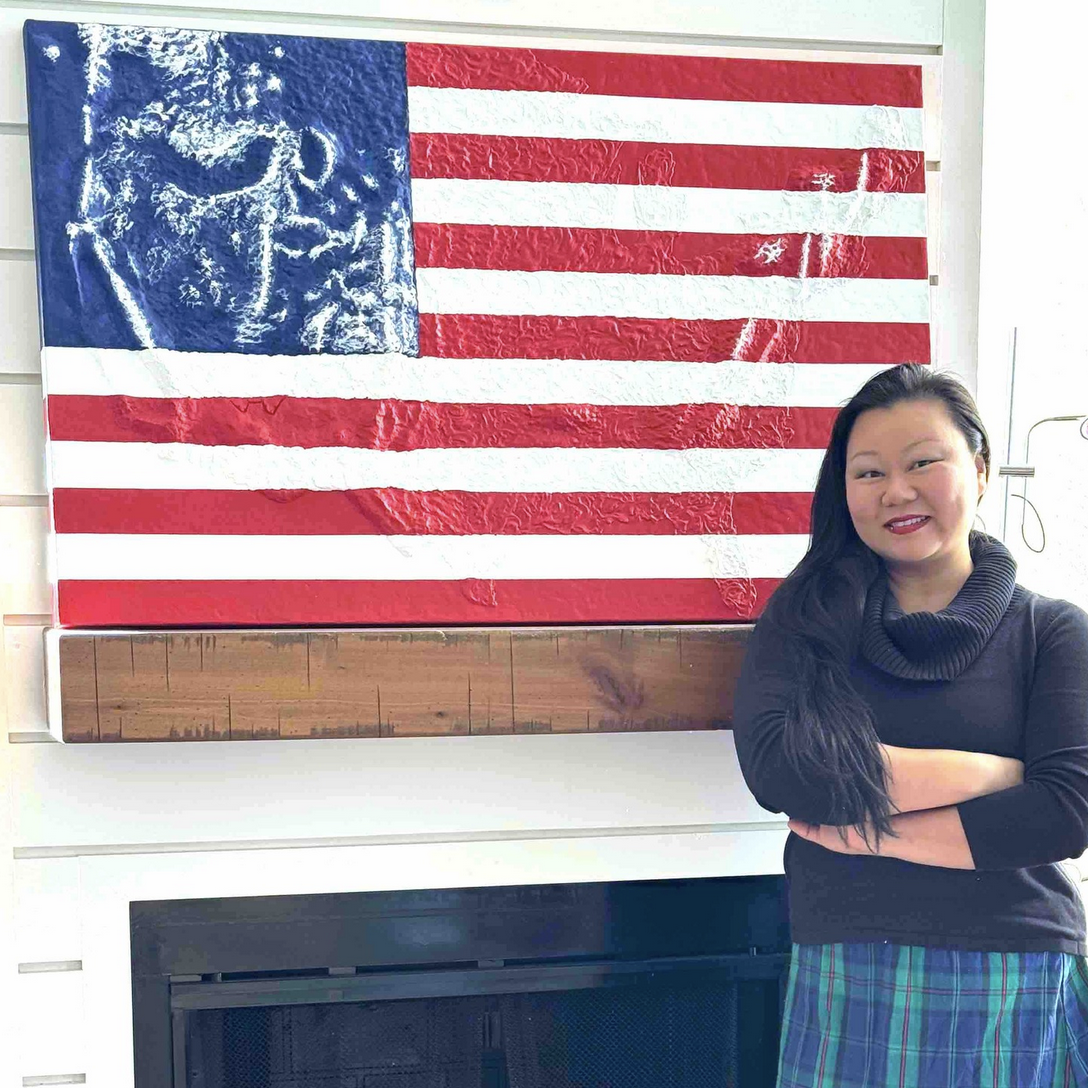
Jing Herman (b. Beijing, China) is an artist, educator, and speaker whose work explores resilience, identity, and the American Dream through thick, textured American Flag paintings and mixed-media works. Born under China’s one-child policy and immigrating to the United States in 1993, Herman’s life and practice are shaped by holding multiple perspectives at once—what she calls “standing the coin on its edge” rather than choosing just one side.
Before dedicating herself to art, Herman built a high-profile career in finance and technology. She graduated magna cum laude from New York University’s Stern School of Business and was recognized in the inaugural Forbes 30 Under 30 list in Finance in 2012. She served as Vice President at JPMorgan, focusing on principal investments in fintech, and later became U.S. CEO of Gett, an Israeli taxi-app unicorn, where she launched and led the company’s New York City operations.
Today, based in the west coast of Florida, Herman creates The Beautiful Country: 50 Flags for 250 Years, a life-time series of textured American Flag paintings that incorporate 100% Made in USA materials—coins, shells, cotton, seeds, minerals, salt, sugar, and other artifacts sourced from across all fifty states and Washington, D.C. Working with a homemade, non-toxic modeling paste made from acrylic paint, baking soda, and glue, she merges her love of nature and love of country with a deep concern for the health and safety of art materials.
Alongside her studio practice, Herman is an experienced educator and workshop leader where she taugh… Read More