
 Apple Podcasts
 Spotify
 YouTube
 iHeartRadio
 Amazon Music
 #054: Ross von Rosenberg: What Do We Owe The Art That Wants To Be Born?
What happens when a meticulous planner meets a canvas that refuses to obey? We sit down with painter and creative director Ross von Rosenberg to unpack a bold shift from figurative storytelling to geometric abstraction—and the moment a red painting revealed the truth he was trying to control. Ross takes us inside the push and pull between precision and spontaneity, how tape lines and millimeter decisions became a language for feeling, and why the work started as a design exercise but turned into an emotional map of a life under pressure.
The conversation dives into the realities behind the art: pandemic uncertainty, a vulnerable IVF journey, and the arrival of his son via gestational surrogacy. Ross explains how fatherhood compressed time and sharpened intention, why short, focused sprints replaced long, meandering sessions, and how presence became more valuable than perfection. We also tackle the art-business puzzle—painting what sells versus painting what insists on being born—and Ross’s nuanced advice to younger creatives about betting on their craft before chasing corporate safety.
Threaded through it all is a thesis about becoming. Ross shares an “I am becoming” statement that names his next chapter: taking a smart leap of faith, trusting the work, and building safety from the inside out. Expect practical insights on process, career, and community, and a reminder that what you focus on expands—fear, or the art that wants to be made. If you’re navigating risk, craving more authenticity, or searching for the courage to step onto the invisible bridge, this one will meet you where you are and nudge you forward.
Enjoyed the conversation? Follow, share with a friend, and leave a quick review to help more creatives find the show.
This is Maddox & Dwight! More than anything, we want to connect and communicate with you. We don't want to think of you as listeners. We want to think of you as community. So, scroll to the bottom of the show notes and click the SUBSCRIBE link. Thank you!
Thank you for listening to the For the Love of Creatives Podcast. If you are enjoying the podcast, please scroll to the bottom of the show notes and Rate & Review us. We would SO appreciate it.
Book a Discovery Call With Dwight
Become a SUBSCRIBER to Get Notified of New Episodes
Want to be a Featured Guest?
00:00 - Welcome And Ross’s Creative Identity
02:53 - From Figurative To Abstract: A Shift
05:28 - Control On Canvas And In Life
09:53 - Discovering Meaning After The Paint Dries
13:33 - Planning, Precision, And The Red Piece
17:38 - Pandemic, IVF, And Emotional Weight
21:23 - Art, Commerce, And Affirmation
25:23 - Advice To Young Creatives And Risk
29:23 - Fatherhood, Time, And Urgency
33:23 - Patience, Presence, And Creative Flow
37:23 - Community, Influence, And Studio Choices
42:23 - Safety, Leap Of Faith, And Becoming
47:23 - I Am Becoming: Naming The Future
51:23 - Autonomy In Relationships And Parenting
01:07:18 - Gratitude And Closing Reflections
Welcome And Ross’s Creative Identity
SPEAKER_01I am exerting control over the one thing, but even that is like fighting against me in a way of saying, like, you can only control so much, allow the chaos to happen, you know, um, allow some of the spontaneity and you know, stop fighting against it so much. So it was about like halfway, but it was that particular painting where it was like, I really realized these were coming from a what had started out with these ones on wood, were like I said, very formal, like, and just kind of like I was I was doing it almost a design, a purely aesthetic project. And then these, like I then realized I was like they were deeply emotional. Um, but it it took a while there. It just kind of like I said, it was kind of a it was kind of a light bulb going off.
SPEAKER_02Hey there. Welcome to For the Love of Creatives Podcast. I'm Maddox and I'm here with Dwight. Hello, my co-host. Today, our guest is Ross von Rosenberg. Ross, welcome to the podcast. We're so glad to have you here.
SPEAKER_01Thank you, Maddox and Dwight. I couldn't be happier to be here.
From Figurative To Abstract: A Shift
SPEAKER_02Yes, we we had a fumble up the last time he had an appointment to record this. We uh got a little distracted and missed our own appointment. So this is take two, and we thank you so much for uh your grace and patience. Um, I'm gonna turn it over to you, Ross, and let you tell our listeners who you are and what you're about.
SPEAKER_01Okay. Yeah, thank you. Um, yeah, so yeah, my name's Rasman Rosenberg. Um I'm I live in East Dallas, uh, and I'm I'm an artist. I've lifelong been an artist. I would even say at this point, I'm really a creative is a better description. Like my primary mode is is painting, but uh I've worked in photography, graphic design, I still work in graphic design, um, collage. I even write on occasion, uh, although I've never really published anything. But um I'm a person that I really like to consider myself as a creative to be an explorer. Um my interests as an artist tend to be a little bit kind of more 30,000 foot view above what are kind of more of the um the kind of like day-to-day earthly concerns, I guess, or whatnot. It's like I'm more kind of thinking about the bigger when I'm when I'm dealing with humans and human emotions, I'm thinking a little bit more of but broadly of like the universalistic, the universal quality of the human experience. And so that's kind of what I'm interested in. But then I'm also just interested in expression for its own sake. Um, and I think anybody who sees my my work or like goes to my website, like they'll see that like where I was at one time is like I am now in totally a different place, and I hope to win I'm 60 to be in a different place and 70 and so on. So um, you know, the finished products are great, um, but the journey is a big a big part.
SPEAKER_02So isn't it beautiful that we get to go through that metamorphosis as many times as we like, and a few times when we don't like.
SPEAKER_03Yeah.
SPEAKER_02Yes, we change throughout our lives, and isn't it grand that that's the case? I don't understand people that don't like change.
SPEAKER_00Well, sometimes it's a little hard when you're you're close to it. I mean, it's we're we're told in some of the the ancient traditions that we have to find the gift in everything. But it can be really hard when you're in the middle of it.
Control On Canvas And In Life
SPEAKER_01Yeah, yeah, yeah. No, and that's the thing. And when you're in the middle of it, I feel like sometimes it's like you don't even, it's not even that you don't even realize it, but you maybe don't even realize how whatever it is is kind of exerting its power onto you. And then when you step back, you're like, why did I why did I make these decisions to create this? And then it all of a sudden it's like some a light bulb goes off, and you go, oh, this is what was it, this is what I was reacting to, you know. Um it's like the most recent, like the the show y'all, y'all came to those those abstract pieces. I didn't I didn't realize at the time, but like I was reacting to, and I think I mentioned this in the artist talk, I was reacting to feeling out of control about so many things in my life, with like my time, um uh, you know, time versus career versus all these things. And I was like basically exerting control on the canvas within an inch of its life. I was like, I'm going to control these things, but then you can see the tension of what I was creating fighting back against me a little bit. And it wasn't until like I was halfway through those I kind of just realized, I'm like, oh, I know what's happening here. And it's interesting because I think a lot of people don't always necessarily think of abstract colors and shapes and brushstrokes as like human and emotional, you know. It people kind of think of it more as as a aesthetic and decorative, and it's just like, no, it came from a very, very like deep place that I didn't realize was happening at the time.
SPEAKER_02It is very deep. And just and because it's abstract, it doesn't have any any bearing on it. I, you know, I think it's interesting because you're describing realizing how representational it is of your life after you you work on the piece, after you paint the piece. And I I'm a baby artist, I'm a newer artist, I haven't been painting for a long time, and I am finding the same thing. I listened to artists talk about, you know, I was going through this, and so I sat down and poured it all out on canvas or poured it out in whatever medium they're working in. And I just can't relate to that at all. I mean, I hear it, but for me, when I paint, it's just my seven-year-old smearing pretty colors on a surface. Yeah. It's just, it's just fun. I'm just playing. But then, like you, afterward, I've been reflecting recently. I've I've been I've I painted a little bit, dabbled a little bit a few years ago, but now it's maybe been five or six months that I'm actively painting. Yeah. And I I sat last week or two, I don't know, two couple of weeks and really looked at the pieces that I've painted. And I I could see a theme. I could see how they correlated to what was going on inside of me at the time I painted them. And it was like I had never heard anybody describing it like that. Everybody else, all the artists that I had heard talk about it, it was always this pre-thought thing, you know. Yeah, I'm grieving, so I'm gonna pour my grief out onto the canvas. And to, you know, me, I'm thinking, gee, I'm not sure I'm a real artist because all I'm doing is just smearing pretty colors on the canvas. But when I had that moment when I could look back and realize how representational it was, some parts of them were reputational, what I've representational for what I was going through in the moment. And then there's this overall theme. You can see aspects of me on an ongoing basis in there. It's like yes, and it's it's it's been I would, and and this I'm leading it, I'm long leadway into a question, but yeah, um it's been really fabulous to realize that it was connected to me in a deeper level than I thought it was.
SPEAKER_03Yeah.
Discovering Meaning After The Paint Dries
SPEAKER_02And so I'm wondering how long you had to paint, because you because you discover that it's after the painting too. You know, it's like you look back and you go, Oh, how long did you have to paint before you had that awareness? Or maybe you had it right away, or uh tell me a little story about how that unfolded, please.
Planning, Precision, And The Red Piece
SPEAKER_01Yeah, no, it's interesting because um, and and it's like, yeah, it's like y'all show y'all saw my show on Art on Art on Maine. There was the the older work that was more figurative and stuff, you know, and had like you know, human figures, and it was a little bit more surrealistic and stuff. So it's like it's really interesting. I first kind of made, I made a conscious transition because I am very in a way calculated as an artist. I do a lot of planning, you know, I have a lot of doodles and stuff, and I really think about particularly prior when I was doing more representational work. It's like you're showing people, like I'm thinking about what's the story I'm telling here, why do I have these people doing this and stuff? But I made a conscious transition of like, I wanted to explore things that were looser, more abstract, less worried about narrative and things like that. So, which was really hard because it's like so many people do abstract artwork and whatnot. Like, and I so I wanted to do something that where I was like, it's not gonna look like what everybody else does. Like, so I thought about it for a long time and I started doing these pieces on wood, and they're very much a cousin to the the very, very tight geometric ones that that y'all have y'all saw at the show. Um, but those were very much kind of me just kind of exploring the space, so to speak. Like it was a very kind of like formal kind of exercise. And then I I switched up to the these ones on canvas, and I would say it was like midway, probably painting through the series. There was in particular, there was a piece. Um I don't know if y'all remember it, it was real red, and it was kind of like these rectangles that were kind of ticking down and twisting. And it was like I really felt like I was fighting it. And what was interesting is I had little sketches and had planned these. Um, because again, I like to plan, I like to have like a foundation, so I kind of know where I'm going. But it would always, all of these would always kind of tilt away from that. Like it was like they would take a life of their own, and it was that particular piece. I just felt like I just I the name of the piece is called like bend so far I fucking break, you know, and so I just felt like it was like I was about to bend and break, and I felt like I was fighting against the painting, and that was the moment where I realized that you know, probably like one in the morning on a Saturday, I realized like I am trying to organize chaos right here. Like, I feel like I am in chaos, I feel like I'm out of control, and so I am exerting control over the one thing, but even that is like fighting against me in a way of saying, like, you can only control so much, allow the chaos to happen, you know, um, allow some of the spontaneity and you know, stop fighting against it so much. So it was about like halfway, but it was that particular painting where it was like I really realized these were coming from a what had started out with these ones on wood, were like I said, very formal, like, and just kind of like I was I was doing it almost a design, a purely aesthetic project. And then these, like I then realized I was like they were deeply emotional. Um, but it it took a while there. It just kind of like I said, it was kind of a it was kind of a light bulb going off.
SPEAKER_02You know, I I don't remember you, I I was there at the artist talk, and I don't remember you saying that it was all connected to control, but that makes sense, you know. When I, you know, and of course, viewers most people listen to this rather than see it if you see it on on uh YouTube, but um your art, what we saw, you know, um had uh well, first of all, I just want to say we we go to galleries like weekly. We we are all over it. We we are seeing art like all the time.
SPEAKER_01That's awesome. I I wish I had the bandwidth to do that. That's awesome.
SPEAKER_02We see a lot of art, and I can say without a doubt, I have never seen anything like the pieces that we saw, your pieces that day. They are very unique, but there was you're right, a level of control in those pieces. It was like it, I mean, I would just imagine that there was down to the millimeter measurements, and there was a precision, and the lines were. I don't know if you tape those off when you when you paint, but the the even that, you know, there is to be a precision with that tape when you're doing, especially when it's not a straight line, when it's a curve. Yeah, those with that tape.
SPEAKER_03I did not paint the circles.
SPEAKER_02It it the precision was something that you would it was so precise that you would have thought perhaps a machine did it. That's how precise it was.
SPEAKER_03Yeah, yeah.
SPEAKER_02Like I've just never seen anything like it. And then yet there were these gradations of color that were, it was it, it's a standout. We see a lot of art, and it it is definitely a standout. But I I love that you're talking about how it connects to your, you know, being feeling out of control and wanting to control something. And I relate to that because I have some control stuff myself, and I am trying to let go of control so I don't paint any straight lines on the paintings. It's it's all very organic shapes because I and they run together and and there's no tape involved because I'm trying to explore the opposite of what I have been, which is kind of a little bit of a control person. Yeah. So it's it's just fascinating to me how all of the emotion and so much of our psyche and things come into it.
SPEAKER_01Yeah, yeah. It was really, it was really an interesting, I think it was a really the first time I can remember where it was like my subconscious had was working on me in a way that I wasn't aware of, you know, initially. It was just like I had I had no idea what I was reacting to at the beginning. And um and then yeah, it was just like, and that's the thing, it was it was, you know, still tail end of you know, working from home with COVID and all that stuff. And then, you know, at the time too, I was working on those. We were uh we were going through the IVF process and stuff. And so it was like just everything felt like a lot.
SPEAKER_02Um and um well, and you are describing big live things that you can't control. You can't control the pandemic, you can't control whether or not the I IVF were I mean lots of things left up to sh just chance, it feels like and the stakes are are great at at each turn on those.
Pandemic, IVF, And Emotional Weight
SPEAKER_00I mean, IVF is expensive. Yes, and it's it's a commitment. I mean, beyond the the financial component, you you are making you're drawing a line in the sand and making some hard decisions about committing to a course of action that can when it ends poorly, it it can be I mean, it it it can it can end in death. I mean it can end in a a lot of uh heartache.
SPEAKER_02Well, and and the same can be said of of abstract art. When you start a series, when you started that particular series, it's it's so individual and like its own thing. There's this point of is any got anybody gonna buy this? You know? Yeah, yeah, will this will this sell? And your painting, just for the listeners to know, your paintings are huge. So there's a really expensive wood substrate going on here, and then there is like an insane amount of of paint. It's very expensive to do this.
SPEAKER_00And to that point, it it's it cannot be said enough. I I've recently had a lot of discussions around that whole argument around whether you you do what it takes to eat or you do what feeds your soul. And there's there's something about your pieces that when uh they're viewed, when they're experienced, they translate into there being something more there. There is something that is beyond just having uh a visual vocabulary. It it's uh it really you look at it and you can almost feel it looking back.
SPEAKER_01Yeah, yeah. No, that's the thing, is it's like I I really want them to have like a a sense the way I describe it is like it's almost like a sense of place. You know, it it's like it's not a room, it's not a monument, it's not a landscape, but then it kind of feels like that. It's it's like if the that's someplace I could go there, whether you know, uh physically or emotionally or you know, in some metaphorical way, like um, so I love hearing that. Like, thank you.
SPEAKER_02Well, and in layman's terms, it is not commercial art. No, no, you know, it is just so far from commercial art. It's and to me, I would say if I had to guess without you saying, I would guess that this wasn't you painting what you thought would sell. This was you painting what was just wanting to be birthed.
SPEAKER_01Yes, yeah, yeah, because definitely like the stuff that started, like the ones that are started on like the stained wood that were, like I said, like the early cousin of where these went. Like those were a little bit more of like again, a formal, a little bit more of a commercial exercise, you know, because like so much of the figurative work, like you know, those figurative pieces at the show, it's like people love it. They they they think it looks really great, they love the artistry of it. But it's also it's it's a tough sell when it's someone's face and someone's body. It's like, you know, they're like, I really like that, but I don't know if I'd want that on the wall of my house, like when people are coming in and out, you know. So it was like when I went to and started those ones that are on the stained wood, which I didn't have any of those at at Art on Maine, that was a little bit more of like kind of dabbling and a little bit more of a commercial concern. But then it's interesting of how it then it did transition. These ones on Canvas were just like, okay, taking that experiment. And doing this is what I really want to do. And if people like it, great. If people don't, I don't give a shit.
Art, Commerce, And Affirmation
SPEAKER_02So Ross, I want to dive just a little bit deeper into that because this is a common conversation with anybody that creates something that they sell. And that is how do you determine whether you create what you what you wants to be birthed, what you you love to create versus what you believe will sell? I mean, we've heard some controversy and we've heard some theory that, you know, if you take if you have faith and take the plunge and paint what you love to paint, that it will sell. And then there's other artists that have come with they've told us completely, I've sold out. I don't paint anything that I really want to paint. I paint what I know will sell. But they also said say that that always it dims their light. It it well, it does more than dim their light. It it turns their painting into just a job.
SPEAKER_01Yeah, yeah, yeah. I know a lot of people who fit in both of those camps or kind of straddle those. And, you know, I think I for the most part have always painted what I want to paint. Uh a big part of the reason of that is is because I've always had a, you know, I've always had a corporate job in in advertising. So it's like I don't have to sell, I've never had to sell paintings to eat, you know, or put a roof over my head. So it's more of like um I get to explore and do what I want to do. And when that intersects with commerce, like in, you know, someone wanting to put it on their wall, it's great, just from, you know, of course, the money standpoint, but it's even greater because it's somebody really accepting something that I love and care about, not a it's not a product, right? It's it's like a part of me and and getting someone to react in that way.
SPEAKER_02It's an affirmation.
Advice To Young Creatives And Risk
SPEAKER_01Yeah, exactly. Exactly. It's affirmation. Like I um I always joke like with anybody like in my family, you know, whether it's like my wife or my folks, like, you know, and they're always like, Well, we really love this paint. Oh, it's so good, you're so good, blah, blah, blah, blah. And I'm like, that's great. And I've always gonna appreciate the encouragement and totally believe it. But I'm like, but also y'all are biased, and so there will be never more it the bias will it will never mean as much as a total stranger walking into a gallery and either having an emotional reaction to something they're created and or like taking it home with them, you know? And that to me, it's it's it's the ultimate affirmation because it's like this person doesn't know me from anywhere. They just they're purely reacting to what I put out in the world that was personal to, you know, any number of degrees or from the moment and time it was created. So I'm fortunate in that way. Um that said though, it's really it's really interesting. I I've met a lot of people, and I've had a lot of like because I'm in the the like corporate world as uh in advertising, is like a creative director. So I've had a lot of people who are like in the corporate world that that I work with or adjacent to, and like let's say they've got like um a family friend or a nephew or somebody who's graduated from college and who's an artist, and they always bring them to me. They want them to talk to me because they're like, you know, Ross has the corporate job, but he's still out and he's still doing the art and stuff. And you know, once upon a time, I would talk about how um, yeah, having like a good, like solid job and whatnot, like it's it's nice because it allows me, again, like I said, to not have to paint to eat. So you really get to explore. My advice has changed over the years. My advice is now, particularly those people coming out of school or anything, is I'm like, don't get a corporate job, go do what you want and explore it now because you're young, you're out of college, your mistakes don't cost much.
SPEAKER_02When you don't you don't have a wife and kids to feed either, or a husband and and kids to feed.
SPEAKER_01Yeah, you only have you. You can live in a shitty basement apartment if that's what you want and pursue your passion. Do that, and then if that doesn't work, you can always like if you got a degree and XY, you can always then go back and get the corporate the corporate world is always gonna be there. But like, so I now tell people, I'm like, go for it. Like, go for it, and if you fail, that's fine. It's easier to fail when you're 28 than when you're you know 38.
SPEAKER_02So am I am I hearing that looking back? I mean, not necessarily regrettable, but do you wish you had done that?
SPEAKER_01Part of me does, yeah, yeah. But at the same time, you know, your path is your path. Who knows where I would have ended up? Um and you know, I'm I'm happy with with my relationships and my life overall. Um, but yeah, I do I do kind of like think back about like having a little bit more not the art, it's not the artistic freedom, it's the artistic freedom time, you know, um, or just like better harnessing that time. You know, you're out of school and you know, you're you have so many other concerns. It's like you got a job, you're trying to meet people, you know, and things like that. And so there's, I guess, also a lot of times where I'm like, I think back a little bit and I'm like, I maybe should have stayed in on instead of going out on that pointless Saturday night, I should have stayed in and worked on my craft a little bit more. But um, but you know, I also believe at the same time it's never too late to kind of like you know transition to pursue your passions, you know.
SPEAKER_02I agree. It is never too late. Here, here I am in the early stages of painting, and I just celebrated my 69th birthday. Oh, that's awesome. And I'm going for it, you know. I'm going for it. I'm I'm actively seeking an artist's studio right now because I I want to get out of the home. I want to have that dedicated place to do that. Um I had another question that I was thinking about, but it may have just gone away.
SPEAKER_00In in that uh moment where you you bring it back, I just want to call out how in the particular lies the universal. And there was a point where both of you shared exactly what your journey has been. And while they weren't exactly the same, there were parts that definitely rhymed in both of your paths, you know, whether it's you uh have uh uh had to deal with a level of needing that control in whichever context and using your art as a a therapeutic uh method of letting that go, of taming that beast.
SPEAKER_03Yeah. Yeah.
SPEAKER_00It's amazing. Uh you you both needed to hear it. As I uh it's funny, uh Ross, as you were sharing, I was I was thinking, wow, this really applies to someone who has been a beauty professional for the past 40 years doing hair and makeup that had to be exactly what you planned from the start. Yeah, yeah.
Fatherhood, Time, And Urgency
SPEAKER_01No, absolutely. Yeah, and and that's the thing. It's like everything is always changing, right? I mean, um, because yeah, obviously, like the big, like, the big new thing that's like just extremely exciting and but like it's like also like, oh my god, like so much, you know, is like, yeah, I'm I'm a father now, you know, is like you know, my wife and I were fortunate to, you know, welcome our our son into the world, like, you know, is the because I mentioned, you know, the the IVF process, which, you know, yeah, that time when I was when I was painting those, it's like, you know, we went through all that. And the first transfer, because uh, we used a gestational surrogate. Um, the first transfer didn't take. You know, it didn't take. And um, you know, it uh I'd I'd made uh there's a there's a painting kind of behind me, that one right there, that was at the time, I don't know if you can see it, like the circle, yes. Yeah, that you know, I kind of had made in an you know, in honor of you know, our process and our idea. And I um and yeah, and it was like I finished it, and then it was like a couple weeks later we found out it didn't take. And um so it's like, you know, that painting ended up taking on a whole new meaning. But then we went through the process again. Um, you know, there was a lot of a lot of pain and a lot of work. I mean, so much of it, like, you know, it's for me, it was like, you know, it was the emotional pain. But I mean, for my wife, like, you know, those meta, it's the medicines on top of it, like, because it's like the hormones and all the things that does to your body. Like, um, but you know, it took. And uh, you know, here we are. So October 18th, you know, we welcomed Ezra von Rosenberg into the world. So uh, and he's growing like a weed, which I'm like telling him, like, soon your dad's not gonna be able to hold you anymore. He's a big he's a big boy, so you know, it and that now it's kind of like what it's interesting. It's like it's interesting, like it's a perfect example of like, so I painted that for a particular reason, something in anticipation of something, and then that thing didn't work out, but then in the end it did, and so it's kind of almost like it's a little bit like you know, um, you know, maybe he just kind of knew, hey, you guys aren't ready yet. So I I'm not I'm not showing up yet, you know. You you aren't ready, you need a little more time, you need another year, another nine months. And so, you know, it was like, okay. And now he's here. I don't know that we're anymore ready, you know, but we're making it work.
SPEAKER_02I don't know. You know, he showed up, so survey says you must be ready.
Patience, Presence, And Creative Flow
SPEAKER_01Yeah, yeah, exactly. It's hard to tell because all you know, it's the uh the communication is just like it's like the different cries, right? Like, and and you start to learn, it's like this one means I'm hungry, this one means uh I have to burp or I'm hot, you know. The I have no idea that like the the gas strict issues were so difficult, like you know, tummy gas or or or burp gas or whatnot. I remember being like deathly afraid of the idea of having to deal with diapers, you know, because I'm just like, oh gosh, I'm gonna get I'm gonna get peed on or pooped on or whatever. And you get over that so quickly. You know, you get over that so quickly. And um, and yeah, and that's the the gap, because it's just like you you then you start to know, you're like, okay, I know he's uncomfortable because of XYZ, but like all you can do is like you know, burp or you know, maybe some like gripe water or like the bicycle kicks with the legs, you know, but like meanwhile, it's like it's gonna work itself out, it's gonna work itself out. Meanwhile, he's you know screaming bloody murder, the only way he knows how. Like, and he's like, I'm sorry, I'm sorry, I'm trying to make it better.
SPEAKER_00It sounds like Ezra is a valuable teacher, too, because going back to the control issues and that whole idea of being ready. Yeah, you're you're never going to arrive at that point where things are perfect. We're always becoming into where we need to go next.
SPEAKER_01Yeah, absolutely. And so that is a that is a learning process. I mean, and and um it it it teach he teaches you how to be patient, he teaches you how to listen. Um both of which are things that like I'm I'm getting better at, you know. Um he teaches you how to value your time, you know. Um like it's it's funny, like over the past, you know, oh since I've been on on paternity leave, like I used to, and still on occasion, I I probably haven't touched sat down at my easel now in a couple weeks, but I have a little bit while I've I've been on leave. But like I definitely sit down with more like intention and urgency than I used to before. I used to like kind of take my time, sit and you know, oh I'll put a movie on on my computer, you know, and I'll kind of watch a movie while I paint. Now I'm just like, no, I'll just pop my earbuds and put on some music. And it's like I go, because I'm like, I got he's taking a nap. He's gonna maybe I maybe got an hour, hour and a half. If I'm lucky, and it's time to get some things done.
SPEAKER_02Um, so it really makes created a search, uh, a an edge of of urgency.
SPEAKER_01Yeah, yeah, yeah. It really makes you like value your time and um just cut out all the BS, right? Like, because it's like you know, soon like it's like okay, I'm gonna I'm gonna have to tend to him, or my wife is gonna, or we're both gonna have to tend to him or whatnot, and be there for him. Because yeah, literally, like they they have no means of helping themselves at all, at all. So, you know, you are you are everything, and it's it's wonderful, it's empowering, but it's a lot of pressure, you know? And um I think the other part of not just like, you know, it's like every time, you know, he's crying about something, it's like trying to solve a puzzle, you know, because there's very obvious is hungry or does he need a diaper change, but like it's like, is he too hot? Is he too cold? Is it like, you know, so you try all these things and you're constantly and the puzzle changes like every time. So there's that patience, but I also think I the part of patience that I'm learning too is it's like as much as I, you know, he's like this adorable little you know, butterball, like it's um I'm very impatient to know the man he's gonna be and like share all the like things with him, you know. I like here's the music that daddy listens to, like, here's the movie, here's art, like here is I'm impatient to like, you know, share the the world with him because that's how I communicate, you know. So I'm impatient for him to understand that level of communication because right now he he doesn't, you know, it's like it's a very it's a very intuitive level. So it's like I'm having to learn to be better about those things and be patient, like all that other stuff is is gonna happen, you know, in do in due time.
Community, Influence, And Studio Choices
SPEAKER_00But I'm I'm hearing the balance is with learning patience and injecting presence. Because the the best case scenario is, and if I may invoke uh Charles Dickens quote, you you're going to raise a fig tree in the way that it should grow so that in your later years you can rest in the shade of it.
SPEAKER_01Yeah, yeah.
SPEAKER_02And enjoy the figs.
SPEAKER_01Yeah, yeah, absolutely, absolutely. No, and um, so yeah, it's just kind of like it's super exciting, but it's like, yeah, it's like patience and areas you didn't even anticipate, right? And um, and then yeah, just having the experience and the presence, I mean, it opens up it gets the creative brain flowing too. So it's also, I'm like, uh, you know, I'm having all of these ideas and and um like creative impulses, but then also finding finding the time and also having the patience for myself of like there'll be time for that. You are gonna get to like, you know, have time to like paint and create again. It's it's all gonna happen and you're gonna get to share that with him.
SPEAKER_02So, you know, uh that's very exciting.
SPEAKER_01Yeah, yeah.
SPEAKER_02To to be able to share your your love with him and and probably you could probably start to share it before he's old enough to even understand. And and you know, it's kind of like I I think we wait sometimes. We wait until we think they understand. It's like I told somebody the other day, I would be a very unorthodox parent if I were a parent. I would teach my children about sex before they even understood. Yeah, because if you say it and they don't understand, then it doesn't mean anything. And if they understand, then they're old enough to hear it. Yeah, yeah, yeah. That makes sense. I would I would and I would do it before they reached puberty. We waited until they're 18 and they reach puberty at 12, average age, which doesn't make sense to me. Yeah, but yeah, that's a whole different topic. But I I kind of want to shift gears a little bit and hear a little bit about how community or what what role community plays in your creative process. Yeah, so as a whole, creative, not just painting, but as a whole, creative process.
SPEAKER_01I mean, definitely is um I'm a I'm a sponge. Uh so I'm always like to be able looking and seeing what's out there, and not just obviously I'm primarily a painter, but like I'm constantly consuming, you know, film, literature, different mediums, um music. So, and there's a lot of that that informs what I do. Um, and I'm kind of a pretty big nerd about it. Like um, I'm usually the person people come to for movie recommendations. Like I I can I can recommend like you know, all sorts of things a lot of times that people have never heard of.
SPEAKER_02But um You and Dwight have that in common.
Safety, Leap Of Faith, And Becoming
SPEAKER_01Yeah. Well, yeah, and I, you know, that's that's one of the things, like it's funny, like um, yeah, having a having a newborn and you're stuck there on the couch, you put a movie on. It's like they have no idea what's going on. So I'm like, oh, I totally have time. And you know, mom's it's her turn to sleep. And so I'm like, it's totally makes sense now to watch all these like foreign movies that I I have in my Amazon queue. So it's like, all right, buddy, we're watching this uh Russian warm war film from 1985. Like it's pretty horrific, but you're a baby, you're looking at me, don't worry about it. So um, but yeah, I I'm constantly taking everything in. I I don't get out to galleries and stuff near as much as I'd like to. Uh that's kind of one of the you know burdens with having like um you know a a corporate job. Um, because unfortunately it's like been a constant like um gripe of mine is I'm like, I don't know why always people like want to start like uh particularly like a lot of like gallery shows on like five o'clock on a Thursday. Cause it's like my my work hours are not like it's not even over until six, you know. So I'm just like I'm like, who has time to deal with because then you you gotta leave the house at 4 30. Like I'm like, how does that work? So um, but I try and get out there when when we can, you know. We uh we took we took Ezra to go see uh the open seater studios, because I've got friends who have studios and stuff down there. So he got he got some to you know meet some some of dad some of daddy's friends, you know, and um you know, and some of them have you know recent littles too. So it's like these are gonna be your buddies growing up, which is really cool. Um, because I'm excited for him to grow up in a creative community and creative environment, you know. Um and I mean, otherwise though, I would say there are some ways, like just because like I it's like I'm very kind of erratic about getting to shows and things, that like I think there's a lot of ways I would like to incorporate community into my process that I'm not able to sometimes. Um I like I'm an only child, so like I don't have any siblings, so I very much have a little bit like man on an island syndrome sometimes. Like I'm I I um I'm a very social person, so I'd like to be out among people. At the same time, I'm somebody who can be in a room with by myself for days, and it doesn't bother me.
SPEAKER_02The best of both worlds.
SPEAKER_01Kind of incorporate some more community aspects into my work and my process, and you know, I think that's I think that's just something that's gonna take like time, you know, as I transition and more into becoming a parent and then you know, just making some other life transitions that you know we're working on as a family to kind of make things more of a cohesive unit in the here in the future, you know.
SPEAKER_02So do you think there's ever a time when you might take your your art studio out of the house and have it someplace where there might be more artists?
SPEAKER_01You know, I yeah, I I'm more open to that than I ever have been. Um and you know, I think that kind of speaks a little bit to that kind of time and and and place and where things maybe are and our lives and and you know, some of my career choices and things like that. Because right now it's like having it in the house, the convenience of it is is nice. It kind of helps like save that time. And then also obviously, like um having an off spot site space, it's an extra expense. So it's like is it right now the calculation is like, is the expense justified by how much I'd be able to go from here over there to use it, you know. But that said, it's like, you know, I've got friends who have really great setups where it's like they're able to have their kiddo in there with them, and you know, if they're and then a computer set up, and like if their wife wants to come in or their partner wants to come in and spend time and it's kind of like it's not just a studio, it's like a family space, but it's a workspace. So seeing that kind of exist in um you know, be actualized is I think a really kind of expi inspiring thing that is making me kind of reconsider that, but it's still it it needs to, I need to make sure it have I'm I'm going and using it enough to justify like the expense, you know.
SPEAKER_02I I wonder if there will be a time where there will be, I mean, when Ezra's not a baby anymore, yeah, and he's you know, running around like a house of fire, and uh the distractions might be so great that you would perhaps need a space away from the the house itself where everybody is.
I Am Becoming: Naming The Future
SPEAKER_01Yeah, yeah. No, it's a distinct possibility, and and yeah, and I think I think that's all like part of that transition of kind of making, you know, there's gonna be a lot of, you know, starting with this, I think throughout the end of this year and into next year, there's gonna be a lot of like, I think for the better, life changes and stuff that you know we're working hard and working towards. And um I'm optimistic and excited about it. And I think I think the root of a lot of it is also just like I think there's a little bit of part of me that I've been working on of like, you know, I think I'm sometimes a little bit, I'm a little bit scared of being who I am, you know, and so it's like really kind of embracing that and running with it and going like embracing that in a way that where it's like it's gonna be okay and it's gonna work itself out and we're gonna be just fine. And um because it's like not being scared, being not being scared of who you are, it's like it allows you to kind of really come into and kind of unlock your unlock whatever your power is. And so I think that's I think there's a part of me that's been holding back for a long time. And uh I'm excited that I think that that's gonna change. And then I'm I'm excited to have, you know, friends and you know, like my wife and my new son, who I think are gonna continue and are continuing to embrace me unlocking that and really bet on myself.
SPEAKER_02What a perfect segue into our conversation about becoming. Tell tell a little bit more. I mean, let's be let's be specific. What I mean, you you know where you are now, and you know what you've achieved now as a creative, and but it's about your whole life because you can't be a creative and not be a parent and a husband because you are.
SPEAKER_03Yeah, yeah.
SPEAKER_02In its totality, you know where you are now and you know who you had to be to get here. What is the next step, perhaps, and who will you need to become? And when I say become, you know, I'm I've learned very quickly to give this clarification. You know, when we were kids, they would say, Well, what do you want to be when you grow up? Well, I want to be a fireman in a restaurant. So I'm not talking about the what do you want to be? I'm talking about the who you want to be. What you want to be is the external process, the who you want to be is the internal process. Yeah. Who in here do I need to become to achieve my dreams that are out here?
Autonomy In Relationships And Parenting
SPEAKER_01Yeah. Yeah. I I think it is, I think one is there is uh, I I definitely have like a big um, I have like kind of like a big safe, like there's a there's a part of my my inner being that like or a part of me that very much thinks about safety, right? You know, there is there is a cautious part of me, which is really weird. Like that's also like um because it's very counterintuitive to to being an artist. Being an artist is not a safe, it's not a safe process. The the process of putting your art out where people can see it and exposing that part of yourself is not none of that is safe, you know. But I think um it is the kind of entrepreneurial aspect of it. There is like the really or like orienting your life and betting on yourself in a way. Um that is the part I think that where it's like there's a safety aspect where it's like I'm working on and having to learn to like let go of that. Like I, you know, the best analogy I I can think of is um, which I'm sure I you know, I feel like it, I feel like everybody's seen uh Indiana Jones and The Last Crusade, right? You know, and um you know, spoilers for anybody listening to this, it's like a 30-year-old movie at this point. Like, you know, but uh if you haven't seen Lyndiana Jones in the Last Crusade, but you know, at the end, it's like you know, Indiana Jones, he's having, you know, to go through the three tests, right? So he can get to the the final test with like the holy grail. And there's the one test where it's like um it's like you know, was it from a leap a leap with a leap from the lion's head, will he prove his worth? And he's standing there, and there's literally these lion statues, and there's just this giant chasm, right? And he's looking at it and he just really he's like, it's a leap of faith. You know, it's basically in this, it's like God is saying, if you if you have faith, if you have belief, you will believe that if you take a leap, and if you truly believe, you're gonna be fine. You're not gonna fall and tumble to your death. And so he he takes that leap, and then obviously you see like the the optical illusion, right? Of like how the chasm, the rocks look like the chasm and whatnot. And so I I think I think that's I think that's it. I think it's working up to be able to take that leap for myself, um you know, and in a smart way, not a reckless way. I think so. I think that's the balance is making sure, um, you know, making sure it's like it's it's done in a way to where it's like we're good, we're gonna be taken care of. So it it it is smart. I I think like there are those cautious parts of me that are don't need to be totally discarded. But I think it's just kind of like there's believing in yourself, and then there's really believing in yourself. And so I think that's I think that's I'm really learning to fully embrace the second version of that.
SPEAKER_02Yeah. I I would, I would just because you have brought this up, I want to share uh briefly uh of my experience. You were talking about safety, and I'm hoping that this will maybe perhaps give you a little different perspective. Um I I figured this out maybe about somewhere around 2017 or 18. So it's been, you know, six, seven years ago, eight years ago. Um most of my life I had exactly what you're talking about, you know, that needing that sense of safety. And I would look for safe people in my life. I would look for safe places in my life. Yeah. And they were rare. They were very, very rare. I I've spent a lot of my life not feeling safe. And then there was something that came about, and I can't even remember what it was now, but somewhere right around 2017 or 18, I realized that I had been looking for looking for love in all the wrong places. I'd been looking for safety everywhere but where safety actually existed. And the big aha moment for me was you can't find safety out here. The safety is in here. You create the safe space for yourself. And when I got that, and when I realized that safety was my responsibility, and I'm not talking about driving safe or not walking in a dark alley at night. I'm talking about emotional safety. Yeah. That putting your art out there, you know, even though it may be criticized or hated or whatever. And in that realizing that I was responsible for my own safety, it shifted everything. I stopped needing safety from other places and people. And the odd thing about it was when I could feel that safety from within, then everywhere I look, I saw safe people in safe places.
SPEAKER_01Yeah. Yeah. There, you know, there is a thing I heard in an audio book I've been listening to, um that has to do it, you know, has to do with business and selling. I'll just put it that way. Uh it's really interesting though. And the the line is what you focus on expands.
SPEAKER_03Yes.
SPEAKER_01Meaning, you know, it is like, and and the example is like, okay, like let's say there is there is something. Uh let's say like you you need a new car and you buy this particular car that you're like, oh, I really like this car. And and it's it's you no nobody I know has this car, right? And then suddenly when you buy on the car and you're thinking about the car, then you see that car everywhere all of a sudden, you know, and it's just because you weren't focused on it, you know.
SPEAKER_02When your wife got pregnant, all of a sudden, everywhere you looked, you saw pregnant women.
SPEAKER_01Yeah, well, because she she didn't get pregnant, it was because we'd had the surrogate. But that's right. I'm sorry, yeah. No, no, no worries.
SPEAKER_02But I'm I'm really awake, I promise.
SPEAKER_01No, but to your to your point though, to your point, it you you're you're 100% on point because as we went through the IVF process, it was like it was like you know, people emerging from the woods, and they're all raising their hands going, like, I I had to do it too. You know, um it's it's crazy. It was like all of a sudden it was like the people were there, the process was there, and what we needed was there. I mean, um, like just you know, it's like finding the for example, I mean, you talk about like miracles and what you focus on expands, like, you know, we're we're going, we're you know, we're going through the whole process, and it's the process of finding someone else to like physically carry your child for you. You know, it's like that's a big ask, right? And um, and it was just we were hitting dead end and dead end after dead end, and then out of nowhere, the um, you know, the the the woman who ended up being um our our our surrogate, she is the daughter of my dad's like best friend of 35 years. And they were just kind of having a conversation one day, and he just kind of my dad's friend's like, oh, you should talk to you should talk to my daughter. She she's always she would love to do that. She loves being pregnant, you know, because she's got you know two kids of her own. And it happened when we were just at so many dead ends, and it just it couldn't have been a better process. And now they're you know, not only helped bring Ezra into the world, but like they're lifelong friends of ours and we'll be continue to be friends of ours. And that's magical, yeah. And it's just like it's what what we focused on, it expanded and it gave us what we needed.
SPEAKER_00So yeah, I'd I'd like to circle back, if I may. Um I'd uh when you were talking about that realization about what the stakes were when you uh needed to when you shifted your thinking about uh going for safety or leaning into growth, it's the same kind of wisdom that's been written about for uh for centuries. Ben Franklin said those who would give up essential liberty to purchase a little temporary safety deserve neither.
SPEAKER_01My favorite that's my my probably one of my favorite historical quotes. No, yeah, it's it's a hundred percent right. And it's it's something that that comes up in philosophy, it comes up in mythology. I mean, you know, it's another and and how it weaves itself into pop culture. Like I said, you know, it's not just Indiana Jones. I think of like the the last of the Christian Bale Batman movies. Like, how was he finally able to get out of the pit? He had to make the climb without the rope, he had to do it with no safety. He had to embrace the idea that if he didn't make the jump, he'd fall to his death. And so it is, it is a it is a thing, it is uh it is mythological within us, like these these stories. Um and I think that I think that's just that's why they're true, that's why they're right. So yeah.
SPEAKER_02So I too want to circle back for a moment and then then it's nearing our time to wrap up, but yeah, I want to circle back and ask you if you could sum up in a sentence or two and start your sentence with I am becoming I am becoming the I am becoming the creative person that I've always wanted to be.
SPEAKER_01A creative person who is truly free to create not just for myself, but create a circle for my wife, for my son, and for all of us to you know truly like go forth and live in like synchronicity and harmony going forward. So that's that's what I'm working on. That's what I'm becoming.
SPEAKER_02How does that feel, Ross? Perhaps the first time?
SPEAKER_01Uh a little bit here and there, you know, but no, it feels good every time I say it, but a little scary. Yeah, but that's okay.
SPEAKER_02Yeah. Yeah, I can I can feel it right now. It's bringing up emotion, isn't it? That's beautiful. Thank you for that. And I'm gonna say thank you for for our listeners because they're this is this is a moment.
SPEAKER_01Yeah, I and I think part of part of that is me being a little bit more comfortable sharing things like this. I'm not I've always not that I'm not like an emotional person or I'm not somebody who's in touch with my emotions or whatnot, but I I I've always kind of projected a little bit of and found a little value and maybe a little bit too much stoicism over my life. And um, you know, just like another good quote, Dwight, is uh, you know, from uh Winston Churchill. It is if you ever find yourself, if you ever look, if you're if you're walking and you look around and find yourself in hell, just keep going. You know? And so that's been my approach to so many things, but at the same time, it's like you you can kind of get buried and stuff. You know, um sometimes you gotta like look up and really look at the possibilities and think maybe I don't need to just keep going. Maybe I have control of the world around me and maybe I can exert some power on that to make it a better place for myself and the people who are in my orbit.
SPEAKER_02We get to fully choose who we become and we get to fully choose how we show up in life.
SPEAKER_01Yeah.
SPEAKER_02And because that's what we're focusing on, that's what comes about.
SPEAKER_03Yeah, yeah.
SPEAKER_02I'm not saying we have full control, but we certainly have influence over our reality.
SPEAKER_01A hundred percent. And I think that's what I'm learning. You know, I um that yeah, it's it's I can choose more readily how I react to things in the world in a way to better shape my reality and to make my dreams and the dreams for my family come true.
SPEAKER_02I I would love to suggest that you write your I am statement down. I am becoming, and it's key to to say I am becoming and not I want to become. Yeah, yeah. Yeah, yeah. And then pause it a little bit.
SPEAKER_01Actualization.
SPEAKER_02Write it down and kind of look at it and tweak it until it says exactly what brought that emotion up a minute ago.
SPEAKER_03Yeah.
SPEAKER_02Good stuff, good stuff.
SPEAKER_00It doesn't have to be one and done. I mean, it's something that you can revisit often.
SPEAKER_02Oh, yeah. Because we're uh every day we're becoming somebody different than we were the day before. Yeah. It's it's like, you know, when one of those big rocket ships heads out into outer space with a specific destiny, it doesn't stay on course. It never stays on course. It veers off course and then they have to course correct. And our same way.
SPEAKER_01Yeah. There was there was a I and I don't remember, uh, I don't remember his name, but there was somebody who was like he he was a speaker at some years ago at like one of our companies, like corporate events, but he talked about like how you know the creative process, and it's really true, it's not like or creative process and the creative and creative achievement is not really a straight line. You really you place a bunch of bets. You do it all, you're doing all of these things and placing a bunch of these bets. And you have to learn how to be flexible on where what is paying off or where what makes sense takes you. Because very much when you are going like, I'm at point A and I want to go to point B, like you are gonna rob yourself of opportunity, you're gonna rob yourself of growth by being so focused on point B. Because point B might change. You might realize you need to go to point C. You might maybe you need to go around point A in a in a circle for a while. Like you you don't really know, but you have to you have to allow for that spontaneity to exist. You you can't fight it.
SPEAKER_02Those are true words of wisdom, Ross. Thank you. I'm I I appreciate listening to that. So I I know our our listeners do too. This has been amazing.
SPEAKER_01Yeah, no, thank you so much.
SPEAKER_02You know, thank you so much for your vulnerability and your realness.
SPEAKER_03Yeah.
SPEAKER_02You know, sharing your your your wife and your child with us. And it's it's this has been amazing.
SPEAKER_01Thank you. Thank you. I I I couldn't agree more. This is this is fantastic. And I definitely like, I don't know when y'all are holding more events and stuff, but I am gonna make it out to one. So uh so definitely I I I want to come out and yeah, continue to kind of work on actualizing being out like in the creative community more because you know, uh it's something I'm actively trying to work on, you know, being connected more to to to other people and stuff like that.
SPEAKER_02You know, what one of the things I almost always hear from parents, you know, as a hairdresser for 40 years, I listen to mostly moms, but some dads too.
SPEAKER_03Yeah, yeah.
SPEAKER_02And there is one thing that all parents eventually realize is that as they bring children into the world, that time away from that child is uber important.
SPEAKER_01Yeah, yeah.
SPEAKER_02You love them to death, but you gotta have a break from them. You gotta have some some of your own time to grow, to learn, to express, to feel, to yeah, to connect.
SPEAKER_01Yeah, yeah. Because we're all still individual people, and you don't wanna, whether it's a child or a relationship, you don't want to totally lose who you are inside of another person. Precisely that's it's kind of people think it's kind of counterintuitive, but like it it's good, it's ultimately not good. It's not good for who you are, and it's not good for your relationship with that that other person because it's like if like in the in the in the case of like myself and my wife, well, I don't want to lose myself totally in her and vice versa, because that totally betrays what the relationship is. Like part of the reason she's here is because she likes who I am, and and the reason I'm here is I like who she is. You know, we love who we are, right? And so then that's the whole thing too, is like what we bring to the table is now as parents is is who we are and our experiences. And if we totally lose ourselves in that part, then we're losing that wisdom we can give to him. We're losing that, um, we're losing all that opportunities that we can give to him, um, you know, to help him eventually navigate through the world, which he's gonna eventually one day gonna have to do without us, you know.
SPEAKER_02Yep. I would I would write that down too, because there's gonna be a point when you're gonna need a reminder.
SPEAKER_01Yeah.
Gratitude And Closing Reflections
SPEAKER_02You know, and and give her a copy because there's a time when y'all are gonna need to remind each other because a child becomes so engrossing that you you lose track of that wisdom sometimes.
SPEAKER_03Yeah, yeah.
SPEAKER_02Good stuff. Good stuff. Dwight, you got anything you want to add?
SPEAKER_00No, we are we're a bit over time, but okay. This has been fabulous.
SPEAKER_01Well, thank you. No, I I really appreciate this. Is this has been great. I mean, I thought it was gonna be great, but it's been even better than I anticipated.
SPEAKER_00So thank you guys for we're so glad that you that you could do this. Yes, absolutely.
Artist
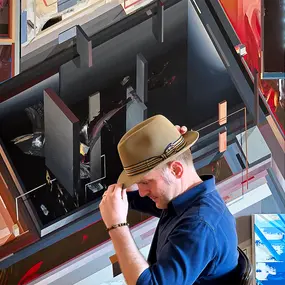
Ross von Rosenberg, 45, is a Dallas, TX based artist and graphic designer that primarily works in acrylic paint, but also other various mixed media. He grew up in Austin and graduated with a degree in Design Communication from Texas Tech University. Ross now lives with his wife and 2 dogs in east Dallas, working as an Associate Creative Director for an ad agency, and continuing to grow and expand as an artist the rest of the time. Ross makes work that ranges from the more figurative and representational to the completely abstract; often with many of his works across that spectrum referencing, informing and influencing each other. Whether the more traditional, or the more experimental, all of Ross’ work is playing with visual juxtaposition, fragmentation, and forms of visual subversion to create senses of place, depth, and artistic tensions that range from purely aesthetic to the more specific story telling of a specific work. Ross’s influences include: Jasper Johns, Rembrandt Harmenszoon van Rijn, Michelangelo Merisi da Caravaggio, Yves Tanguy, Frank Stella, Joan Miro, Jean Michel Basquiat, Andrew Wyeth, Ralph Steadman, Marcel Duchamp, Piet Mondrian, Robert Rauschenberg, Gerhard Richter, Salvador Dali, Francis Bacon, and Jackson Pollock.