

 Apple Podcasts
 Spotify
 YouTube
 iHeartRadio
 Amazon Music
 #058: Bonnie Daneker Finds Herself After a Lifetime of Caring for Others


Have you ever looked up one day and realized you’ve been taking care of everyone… but somehow lost track of yourself?
In this deeply tender conversation, we sit with writer and literary guide Bonnie Daneker as she shares how a life shaped by caregiving, loss, and constant responsibility slowly pulled her away from her own inner world… and how writing became the place she could finally hear herself again.
Bonnie talks about caring for loved ones through illness, the quiet ways women learn to disappear inside service, and the moment she realized she didn’t actually know how to be present for herself. The page became more than a creative outlet… it became a mirror, a refuge, and a way back to her own truth.
This isn’t a story about building a career. It’s a story about surviving, grieving, and gently reclaiming the parts of yourself that got set aside in order to keep going. It’s about the strange grace of letting words hold what life couldn’t. And it’s about discovering that creativity doesn’t demand that you be strong… it simply asks you to be honest.
If you’ve ever felt like your creative voice went quiet while you were busy being everything for everyone else, this conversation will feel like someone sitting beside you and whispering, you’re allowed to come back to yourself.
Bonnie's Profile
Bonnie's Website
This is Maddox & Dwight! More than anything, we want to connect and communicate with you. We don't want to think of you as listeners. We want to think of you as community. So, scroll to the bottom of the show notes and click the SUBSCRIBE link. Thank you!
Thank you for listening to the For the Love of Creatives Podcast. If you are enjoying the podcast, please scroll to the bottom of the show notes and Rate & Review us. We would SO appreciate it.
Book a Discovery Call With Dwight
Become a SUBSCRIBER to Get Notified of New Episodes
Want to be a Featured Guest?
00:00 - Origin And Early Spark
03:23 - Journalism To Arts Promotion
06:33 - Family Crisis And Caregiving Books
12:43 - Building A Literary Consultancy
17:53 - Burnout, Loss, And Resilience
22:33 - Stereotypes, Confidence, And Coaching
28:43 - Choosing Wisdom Over Ego
33:33 - New Chapter In North Texas Arts
39:23 - Staying Relevant Through Curiosity
44:53 - Joy, Learning, And What Comes Next
52:53 - Closing Reflections And Support
Origin And Early Spark
SPEAKER_00And we had a conversation about caring for cancer patients, and I felt like I was blindsided. I didn't know what was coming next. I didn't have any kind of medical training. But he said, you know, if you don't know how to care for cancer patients, maybe other people don't either. So this was the early 2000s, and he said, You're a writer, Bonnie, why don't you write a book? So I ended up writing five books on caring for cancer patients because my publisher said what I had was a little too big. I ended up being five.
SPEAKER_01For the love of the gosh. Sometimes I do a flashback to my previous podcast and say the name of that, and huh? Oh well, it's a senior moment. So today we're delighted to introduce our guest, Bonnie Daneker. Bonnie, take a moment, maybe one to two minutes, and just tell our audience a little bit about who you are and what you're about.
SPEAKER_00Oh, thank you for having me, you guys. I love what you're doing here. Um, I am a professional writer. I have multiple books and multiple titles in multiple genres in my background. I worked as a book coach for 20 years and I am a publisher. So I manage properties in the literary space as well. Um, you know, my background, I kind of came up through the journalism training and into marketing and into marketing for technology, which brought me into technology project management, which really gave me the background to um open my own literary consultancy and help people write books. So as I look to the future, you know, rounding out this decade of my life and the next decade of my life, I'm kind of opening some opportunities creatively for the next steps.
SPEAKER_01Sounds exciting.
SPEAKER_00Yes.
SPEAKER_01It does sound exciting. I can't wait to hear.
SPEAKER_00Yes. It's um it's full of wonder and it's amazing when you put it out there. Not only do the opportunities surface, um, but the people who might help you with those opportunities surface as well.
SPEAKER_01Isn't that a beautiful thing? So let's let's do a little bit of an origin story. How old were you when you figured out you were drawn to creative things?
Family Crisis And Caregiving Books
SPEAKER_00I was a very young girl. Um, my parents tell this story. Uh, I mean, they're deceased now, but they used to tell this story that um as a four-year-old, I would go around the neighborhood and talk to my neighbors. And um, it was a very small town, so it was safe to do this. But I would end up at um Mr. and Mrs. Secret's house, and they always had chocolate chip cookies, which I loved, I still love. Um, and you know, I would talk to them about, you know, what was happening in the neighborhood. And I didn't know it, but Mrs. Seacrist always called my mom and said, you know, little Bonnie's here and she's okay and whatever. But um Mr. Seacrist told me years later, um, you know, he was a councilman and then he was the mayor, and then he was a senator, but he really valued my feedback as to what was going on in the neighborhood because people would tell little four-year-old Bonnie, five-year-old Bonnie, and six-year-old Bonnie what was going on, um, where they might not tell, you know, 40, 50, something-year-old politician what was really going on. So that actually um kind of ignited my interest in community affairs. And another one of my neighbors was the editor of our Tri-County newspaper. And she gave me the opportunity to um begin my journalism career by publishing my first news story at age 14. So I had a byline about what was going on in the community. It was a story on the new Teen Center at 14 years old in a um a publication that had a 30,000 distribution. So that it was really, you know, again, the universe put the people in place to help me make some of those things happen. And I was a straight shot for journalism. I knew I loved it. I wanted to do it, did not change my major once in college, um, double-majored and double-minored in journalism and um public relations and then English and theater because I had this love of creativity in all forms, okay, the written form, but also theater, music, dance. Um, and my dream job was to work in New York City and do some promotional writing, which I actually did after a couple of short stints um in newswriting. But um I worked for the New York State Council on the Arts. I worked um for many galleries and did a lot of promotion of other people's works. And I really thought, you know, that's that's kind of my sweet spot. Um I ended up coming back to Ohio um after a short stint in um law school. I thought I wanted to be an attorney for protection of intellectual property. Um, my dad was in a bad car accident, paralyzed on the right side of his body. So I came back and helped to care for him. And then um I realized I wasn't making enough money in the arts and went into marketing, um, which again led me to marketing telecom and the project management there, a more entrepreneurial journey. But I um I have my father to thank for many things. And another one um, which was um a burden for him and it ended up being a blessing for me, was you know, he when I was working as a technology project manager, he was diagnosed with cancer and was given eight weeks to live. So um, in addition to prior challenges that he had, um, you know, eight weeks. So I went to help him there and we had a conversation about caring for cancer patients. And I felt like I was blindsided. I didn't know what was coming next. I didn't have any kind of medical training. But he said, you know, if you don't know how to care for cancer patients, maybe other people don't either. So this was the early 2000s, and he said, You're a writer, Bonnie, why don't you write a book? So I ended up writing five books on caring for cancer patients because my publisher said what I had was a little too big. And then um, after he died, I um I had a business to help caregivers of cancer patients. But um, yes, I was notified by um a gal that I worked with in the technology project management that she was um gonna put together a book for the women in technology and asked me if I wanted to be part of the project. And it occurred to me that this was a life-changing moment, also, where I could bring my creativity into the science of technology and kind of honor these women and help tell their stories. So I co-edited a project called Climb. The leading women of technology shared their journeys to success. And you can actually see, well, I guess you can see the corner of that book, but I've got the book cover framed because it was so important to me. Um, but I interviewed a lot of women, a couple men, but on how they went into this very challenging role and how, you know, they their stories. And in that process, you know, I met a lot of women who said, I've always wanted to write a book. I don't know how. And at this point, I had written several books. That was my seventh, um, if you if you consider that co-editing um writing, you know, obviously there are a couple sections in there that I personally wrote, but um, but I ended up starting the first literary consultancy in the state of Georgia where I was living at the time. And um, that was feeding my entrepreneurial spirit. It was feeding my literary spirit, my creative spirit, and of course, my love for fellow women entrepreneurs. And um, you know, they were all entrepreneurial in their field. So that started a 20-year love affair with publishing um other people's work. I mean, I published my own um uh here and there, um, but mostly was in a supporting role to help them creatively tell their stories. So I worked mostly in nonfiction, although I did create, I helped create um projects in the fiction space and children's books and so forth. But um, you know, after about 120 projects, I um decided that it was going to be time for me to wind down. So COVID was a particularly busy time for us in publishing, um, bad for a lot of other industries, fantastic for publishing. We had a demand for a lot of content. We um were writing a lot, we were reading a lot, we were producing made for TV movies, um, and I really experienced burnout um the first two years, 2020 and 2021, working on so many different projects, um, full books, content extensions. Um, and I decided that I was going to wind off that. So I completed my very last, um, I'm hoping my very last book coaching project um at the end of 2025. I love my clients. I love the the books that I've helped produce, but I need to um move forward with uh, you know, a couple of things like I mentioned in my life and let those contributions speak for themselves.
SPEAKER_02Well, I just want to applaud you for having such a positive frame on some things that could have been just uh life-ending for a lot of people. I mean, you you were so graceful in the way that you described some things that I know were challenges. I I can't imagine the pain of having to uh be with your father when he had his health so compromised. And the the way that you navigated some of the twists and turns with life. You know, you you tried a few things and you know, law school wasn't the thing, but you you continued forward. And my goodness, look at look at how you've paid it forward.
Building A Literary Consultancy
SPEAKER_00Well, thank you. And you know, I I do spend time and contemplation. I've lived in a lot of states, a couple different countries. I've worked with so many different people, I've seen the beauty of people's responses and tried to learn so much about my own responses and how I can be and become, as your podcast is is focusing on. Also, I want to become a wise woman. I want to be known as someone that people can talk to and trust. They can um they can ask for guidance or other ways to look at it that they can um just be with during sensitive times. I I really feel like I've spent so much of my career in a listening mode. And part of that I've got good training from my journalism studies, but a lot of it, you know, being a book coach, um, that has been reinforced in me to be curious and really help people find the essence of what they're trying to explain and share. Um, so furthering those kinds of skills that I have and knowing that I want to be perceived as that in the future has really helped me kind of define where I want to go and help me to try to acquire some skills to get there.
SPEAKER_01I I would say that you are well on your way to that woman of wisdom.
SPEAKER_00Thank you.
SPEAKER_01Well on your way. You said something earlier in the conversation about I can't I can't recreate it verbatim, but it was something about making a decision to go in a direction and the the right people and the right resources and the things just show up. And now hearing your story, your past, I can clearly see why you hold that belief because it sounds like just everything unfolded like magic from the time you were four years old on. I I mean I'm thinking you must be working off some really good karma. You must have been really like put some good stuff out into the world in previous lifetimes because you're describing something that sounds magical to me.
SPEAKER_00Thank you. And it was very magical. And there was heartache, of course, throughout. And there, you know, we don't get to middle age without being a little scarred. But um I I really did grow up in in quite an interesting family. You know, my my mother spoke five languages, she could create anything artistically. So I I get our um interest and creativity from both my parents too. You know, my mother could she taught home economics, bio uh, you know, nutrition, um, biomed. Um, she was amazing. She taught home ec, she taught me to sew. I was able to start a christening gown business because of that. That's another story. But my father was an architectural engineer, um, multiple patents, was always thinking about new creative ways to do things. And in our house, it wasn't acceptable to leave problems at a status quo. Um, you know, my dad used to say, uh, if you've got time to complain about it, you've got time to do something about it. And all my brothers and sisters, and I'm one of eight, um, number six, and all my brothers and sisters have a problem-solving attitude. You know, they they don't um have a victim mentality that that I'm aware of. You know, they they see things and think, how do you, how do you get through that? And that's another thing my parents would say to me is, you know, you come to an obstacle like a brick wall. Okay, if you can visualize it, how are you gonna get beyond that brick wall? You know, are you gonna are you gonna go around it? Are you gonna dig under it? Are you gonna climb it? Are you gonna hire a helicopter, drop me on the other side? Are you gonna clock me, you know, what what do you do? But um, it shouldn't stop you if your goal's on the other side. And and that to me is an example of creative um thought, too. I mean, you you've got to have some direct line again of what your goal is, and then think through what are creative ways to get there. And um, you know, that's one piece of wisdom that I would like to continue to impart when people ask me about, you know, their career or their um, you know, another personal challenge is what do you want and what's kind of stopping you from getting there? And how can we look at this and and maybe maybe craft something so that when you look back, it will, it could be viewed as something that ended up being positive. It's not positive now. I'm not diminishing the you know impact of some of those obstacles, but you know, when you look back, it can be it can be positive.
SPEAKER_01That's really true, Bonnie. I can look back on some of the hardest moments of my life, some of the traumatic experiences with gratitude now because I I I see the role they played and and what a big part of me they are, and and wouldn't wouldn't want to relive it, but certainly wouldn't want to change it either.
Burnout, Loss, And Resilience
SPEAKER_02Yeah, I think we've all had some of those. I I recall my own COVID experience was one of saying a long goodbye to a longtime partner. Uh and it was it was that same kind of an attitude of, well, uh the stakes are real because death is on the table. So what can we do to make things better? What can we do to uh set ourselves up to make sure that we can be in good shape for uh being a candidate for a liver transplant? What can we do to um get all of the all the things that we need to make things more accessible at home? What can we do? And there was nothing was off the table. If we needed to to raise funds, we got creative. And uh it was one of those things where I remember one of the early hospital stays, he said to me that we're going through some of the worst times right now, but we're we're making it some of the the best time that we'll spend together.
SPEAKER_00Some nice memories in the middle of all this tragedy. Yeah, I can hear that in your voice. It's it's no fun. I lost several people during um 2020 and 2021. That was also, you know, what was going on. I we moved to a different state um, you know, the year prior. Um had a historic house where things are falling apart. I mean, like, uh, there were so many things, but um, you know, you can laugh at some of those things now. I'm sorry you had to go through that, but at least you have some really good memories at the end.
SPEAKER_01Yeah.
SPEAKER_02Special time.
unknownYeah.
SPEAKER_01We we've we've looked at kind of one, you know, each coin has two sides. We've looked at the side of the coin that has a pretty glamorous story about everything that's unfolded in your life. But let's take a look at the other side of that coin and share, perhaps in all that, what was the biggest challenge that you had to overcome?
Stereotypes, Confidence, And Coaching
SPEAKER_00So, you know, first I have to take a slight tangent and and uh give you some background. Um, but I um went to the Modern Elder Academy in August, which is a wonderful um institution in New Mexico on a ranch. And it's um started by Chip Conley, uh, the hotel year, Chip Conley. And his idea was, you know, we've got lots of schools to teach us how to be whatever we want to be at different phases of our life, except nothing on how to be um a really um wonderful contributing elder. And um, my husband and I went, and the whole theme is moving from becoming a consuming caterpillar to a benevolent butterfly, right? That's the whole essence, and then what finding what your strengths are and then using whatever strengths are, your best strengths at this time of your life in the best ways, right? So one of the things they say there um was um, you know, come into your room. Whatever the room is, with energy and positivity such that they don't see your wrinkles, right? So, which I love. And I'm glad to talk more about that experience also because it is formative for me. Um, but with that, you know, one of the big challenges that I've always faced is um, you know, I'm I'm a tall blonde. Um, I am naturally very positive. But in my younger years, I was really effervescent. You know, people called me bubbly bonnie. I at first I liked it. Um, but you know, then it was um it was the dumb blonde syndrome. You know, people kind of assumed that um for many, many years of my life that because I was blonde, um I, you know, I wasn't qualified, I wasn't smart enough, I didn't have other qualifications to do what I was doing or um to hold the job that I was doing just because of the way I looked. Um and, you know, yes, I've modeled and I have met some beautiful people who haven't worked on their um their mental capabilities or intellectual capabilities as much as I have. But I have a master's degree and multiple certifications. I'm a pilot, you know, I'm I I've raised her, you know, there are so many, there are so many things that I could say in defense of that, but I stopped fighting that. You know, that that was part of my life for many years. And frankly, even sometimes I still get it, like, oh, she can't be that smart. Um, but you know, let you think that, and I will run circles around you, or I will do what I need to do, um, you know, with without your support. Because, you know, it used to hurt me very, very much. Um, you know, I had comments like, who'd you sleep with to get to this job? Or, you know, um, Bonnie can't handle that. She's too pretty, she won't get her nails cracked, or you know, stupid things like that. Like, are you for real?
unknownYou know?
SPEAKER_00Um, but that would say I would say is is a constant, well, was a constant issue, but as I get older, it's less and less of an issue.
SPEAKER_01What what do you think enabled you to go from it being a big issue to it not being so much of an issue? What was what was the essence? What had to who did you have to become to get beyond that?
SPEAKER_00I have worked with a number of executive coaches over time. I mean, I've also worked with athletic coaches and personal trainers, but specifically a couple of um female executive coaches were adamant. Both both of these two women um were adamant about me taking an inventory of my life and what I had accomplished at that point. I mean, they were at different points of my life. One was just even um 10 years ago, and the other one was maybe 12 years ago before that. But um, you know, realizing like how could I think anything except that I am qualified to do this work, whether people see it or not? Um, and how can I be strong inside so that I don't have to keep defending myself? Um, they they were really good about tabulating and writing down documenting. I mean, I I'm in the literary arts, right? Why haven't I documented for myself? It doesn't, I mean, I I started really bulking up my LinkedIn profile. And I mean, now I'm actually doing the opposite, right? I'm narrowing down some of that stuff. But um, my my five-page resume, my, you know, um portfolio, which was, you know, that big when we had printed portfolios of written work, and um, and uh I just um I finally realized that if you don't believe I can do the job, maybe we don't need to work together. And for you. Yeah. I so it was with the help of those two coaches because I I wasn't seeing it on my own.
SPEAKER_01Bonnie, I I have I'm I'm a very intuitive person, and I'm I'm having an intuitive hit right now that I should share this with you. And it may be something that you already know, but what's coming through right now, and this isn't of me, it really does come through me, is those people that that thought that way, felt that way, had those things to say, it's highly likely that those people felt threatened by you. You walked, you know, the first time I ever laid eyes on you was at Creative Mornings. And you walked in, and across the room, you walked in with an energy of authority. You owned the room. I mean, you walked in. I mean, it's 8:30 in the morning, and most of us are slugging in, pulling out of bed with hats on our heads because we didn't have time to do anything to our hair. And Bonnie comes in, hair done, makeup done, fabulous outfit, tall, slender, blonde, heels, and you you walked in with this energy that said it all. You didn't have to do anything or say anything. It said it all right there. I I thought, wow. And then you walked up and introduced yourself and spoke to us, and it was even more wow.
SPEAKER_00Thank you. Well, it's taken a long time to get to that point. I mean, now I I mean, like I said, I've lived in several states and I I know that people aren't going to come to me generally unless they've known me for years, right? But in a new environment, uh I have to do that. And, you know, as I look to March, that will be three years that we've been in Dallas. But the first year was really a transition year, um, you know, moving back and forth and changing apartments to a house and so forth. But I I was looking for that stability in um people that would know kind of what I what I have to give um without me saying a lot. And I really appreciate that you recognize that.
SPEAKER_01Immediately, you know, you know what my mama would say about all those people that had things cutting words, she would simply say, Bless their hearts.
SPEAKER_00Right. Thank you.
SPEAKER_01Thank you.
SPEAKER_00Exactly. Well, yes, but you know, I mean, when you when you grow up in a small town, people's opinions matter and all that stuff. So I did carry a lot of that. And even though I lived in some of the biggest cities in the world, you know, Mexico City, New York City, Chicago, um, I I well, actually, those places did harden me a little bit and realize make me realize that, you know, it's them. So whatever they're carrying, you know, so be it. I can just wish them well, and and I'm in such a better place about it. But thank you.
Choosing Wisdom Over Ego
SPEAKER_01You know, something happened to me just on Sunday morning. I will share. We had been invited to a little brunch, yes, and and we went, a friend invited, and then we met two new people that we had met. It was small, there was just the five of us, and I put on uh uh a ragged holes and stains on them, a pair of vintage 501 Leaf eyes, and I had on some suede boots, very dressed down. I think I had this pale pink um sweatshirt on, and it's head I had a faux um leopard coat on, faux fur. And as we left the restaurant, it was packed. This woman looks up and sees me, and she gets her boyfriend, husband, whatever attention really quick, and they're staring and they're getting a kick out of this. They're they're making fun of me, you know? And I and I and I completely I saw it, and I actually just got the biggest kick out of that.
SPEAKER_00I mean, I just hilarious.
SPEAKER_01I got a kick out of it. I said to Dwight, I had to just there was two things that were on my mind. I had to bite my tongue and keep walking because I wanted to walk over and touch her on the shoulder and say, You like my coat? Yes, and then it's what I'm saying was they'll be like, Honey, who is that? I'm gonna say, Honey, where are you from? Have you never seen a homosexual before?
SPEAKER_00There is yes, bless her heart.
SPEAKER_01Bless her heart. And I laughed all the way home because she was making fun of me, but the joke was on her because they look like they were from Podunk.
SPEAKER_00Well, you brightened their horizons, didn't you?
SPEAKER_01They're probably still talking about me. I know.
SPEAKER_00Well, good for you. I'm sure you're very stylish.
SPEAKER_01Well, let's thank you. Let's move on to the the the the new, the the the where you're going part of our conversation to hear what this new plan is that you're excited about and who you're gonna need to become to step into that.
New Chapter In North Texas Arts
SPEAKER_00Yeah, yes, you know, um with a new physical geographic move comes a lot of thought about who am I going to try to meet or what groups am I going to join and so forth. And so I spent um part of the first year and part of this, I guess the year and a half going to a lot of different groups and saying what was happening here in this um, you know, Dallas-Fort Worth area. And we actually bought a house in Plano, north of the city, and um it's um, I don't know exactly what the population is, but there is a lot happening here in Plano too. Um as big as Dallas or Fort Worth, but it's a lot happening here. So um it came to me that I have had so many people support me and um and I really wanted to roll off book coaching, but had my responsibilities as a publisher for a little while that I wanted to maintain, and then also that I really enjoyed writing. You know, I've been writing on and off um all these years, even uh you uh managing other people's properties and and coaching them through producing their own books and and book extension projects. But I I went to the um went to the mayor's dinner and f and met a wonderful woman who is you know the owner of Chamberlain Um Ballet, and she told me about the Leadership Art Institute, and that is um one of the things I know you guys are involved with as well. And that really introduced me to a lot of arts organizations in this area, and I realized what I wanted to do is continue advocating for other artistic efforts and help people in meaningful ways where I wasn't just volunteering at another person's book signing, or I wasn't just you know giving$50 for the the latest GoFundMe campaign or whatever. And so I've focused on two communities that I am becoming more active in, and one is the Plano Symphony Orchestra. My mother played concert piano. I did promotional writing for the arts for many years, as I mentioned. Um, I worked in the Ohio State University Um College of the Arts and became a board member for them for seven years in the society board member. So I had that background and I wanted to put it to use. Um, so I um I started volunteering for the with the Plano Symphony and the Symphony Guild and then was nominated for a board position, which I um applied for and it was accepted beginning um last July. So I have the opportunity to slowly but surely make an impact to an organization that is not only creating beautiful music and collaborations with this music for all ages, but also fostering the artistic community and music for um playing and composition uh in youth. So there's a whole music education area, there are music camps, there are um music contests, competitions, and that just is really joyful for me. So I'm doing that, and I'm also working with the University of Texas, uh University of North Texas in Denton, in their Center for Visual Arts and Design, which um also feeds me from a visual perspective. I had worked briefly with Savannah College of Art and Design. I miss that. I miss being around students, especially students in the creative space. So I will be, I am um an ambassador for the school, um, specifically that center, where they do a lot of visual arts um work in collaboration with other colleges. So the business school, the um engineering school, the music school. So, how are visual arts integrated in some of these practices, which is really exciting. And they have a fashion institute, Texas Fashion Institute, which feeds my love of creativity in the garment space. And so between the two opportunities I have, being on the board of directors with the Plano Symphony and being an ambassador for the Center for Visual Art and Design, I feel like not only can I slowly learn from them and what they're doing and the youth and the energy that these people bring, but also maybe I can impart some energy back and um and promote them and help them be seen and appreciated uh by a you know the North Texas area, if not, you know, the greater region. So this is this is a tremendous opportunity. I'm still uh you know, touching the publishing industry until I roll off some of my management responsibilities there. But my life going forward will be definitely weighted towards the um the volunteering and um and promotion piece of it, where it's it's all about the arts for me. So that's what I'm heading to, and I I welcome the change. Um, even though I love my my business background, I love my my NBA and my fellow entrepreneurs, you know, I'm focusing on supporting that next generation of artists.
SPEAKER_02That's that's amazing. And those the way that you are working across uh multiple communities here in this area, I mean, you're you're going to have impacts that will have um you're not going to be able to comprehend just how far reaching the ripples will be. I it's it's amazing to think about.
SPEAKER_00You continue to touch my heart, Dwight. Thank you.
SPEAKER_01Well, that's the goal. We may have some connections for you. Great. I'm I'm I've got I've been writing down some things as you've been speaking because I have at least two people off the top of my head that I want to introduce you to. So I'd like to go a little bit deeper if we could. Sure. You have described the becoming part on the external level, the different things that you're getting involved in. I'd like to go to the internal now, that part of what needs to become in here inside of you to flourish in all of those things that you're embarking upon in the external. Does that make sense?
Staying Relevant Through Curiosity
SPEAKER_00It does. And one of those big things is insecurity, you know, the venueness, um, but also of what I think is crystallized wisdom to use a modern elder term, but that may not be so crystallized. I mean, it may be a little wishy-washy, or worse, y'all, not relevant, right? So I went to dinner. I was thinking about was I gonna talk about this with you guys or not? But um, my husband and I went to dinner with this other couple, lovely people um in their late 80s. And he was talking to me about some of his experience in the 1970s. And um generally I love that stuff. Um, you know, it fits right into like, oh, let's make a biography of this. You know, I can listen to that stuff generally all day. But then, you know, his perspective was this has worked since the 70s and this is how it should always be done. And that really um disappointed me. And I thought, you know, half a century has gone by and your thinking hasn't updated. And this is something that I want to work on internally because I think I know some things, but I don't know if they're relevant to my audience. And I gotta always be aware of that. And that's that's been, you know, one of my gifts and one of my challenges the whole time in the literary arts is am what I'm saying relevant to you? Are you gonna buy the book? Are you gonna read the blog? Are you gonna listen to my keynote because it matters to you? But as I'm getting older, I don't have the latest technology experience. You know, I'm not in a corporate environment where they're trying, you know, the newest apps and so forth. I am not um privy to, you know, what's the old way of doing things as much as I would like. And so I am learning, and this is very hard, what I think are, you know, universal maxims are sometimes not relevant at all. And so being aware that I might have something to say, but it may not be worth anything. So um, you know, being less of a talker, I mean, I'm talking a tremendous amount, and actually, funny, funny thing, they they invited me to be on a panel last year at a publishing workshop, and I talked way too much, but I said, this is my last one in publishing. So I'm gonna just put it all out there. Um, but no, really, that's that's one of my um my words um for 2026 is preparing um and preparing my responses is what this context is for what do you really need to hear? What do you really need to hear from me? So being more um interested, this is another thing from Modern Elder Academy, being more interested in what you have to say and what you need than interesting, like I have this cool background, you know, I should just share it with you. Well, that's not maybe what they need. Maybe they just need a good listening ear and then to summarize what they're saying or maybe offer a slightly different angle that will help them with other ways to solve the problem. But this this is challenging because um, you know, everybody knows it's easy to talk about yourself.
SPEAKER_02Sure. Well, and I I have to applaud you for being so um aware when it comes to uh when it comes to making it so that we can make room for people to actually tell us what's relevant. It's I think it requires a an amount of awareness and a little bit of uh a skill for being able to use our senses in proportion, right? We have the two ears. And we we really need to allow for people to lay out the road for us. And unfortunately, I think there have been so many ways that we've been conditioned that if you're not uh screaming from the mountaintops what it is that you do and what you're worth, then people will ignore you. And it's such a an upstream counter move to listen intently and find the way that you can weave in exactly what's needed at the right time. And I I definitely hear that you have that as a skill that you're you're trying to hone. That's the axe you're sharpening, and good on you for it.
SPEAKER_00Thank you. Um, you know, we talked, my husband and I continue to talk about this. Um as we move forward in age, there's a saying of we move also from who's who to who's that, right? So have you heard that before, Maddox?
SPEAKER_01I have not heard that, but it's it's so true, right?
SPEAKER_00All of a sudden, I mean, you might be a big wig or important in one part of your life, and then nobody knows anything about you later on, right?
Joy, Learning, And What Comes Next
SPEAKER_01You know, I heard a story one time that really drove that home. What one of my friends was telling me he was in, this has been a while ago, when we still had music stores, and he was in thumbing through the CDs or whatever it was, and there were two young guys on the other side of the you know, the counter there, and one of them says to the other one, I told you Paul McCartney was in a band before Wings. Drives that home really, really well. You know, I think that as you talk about relevancy, that's been a really big thing for me. You know, I'm I'm 69 now, staring at that big 7-0. And I think a lot about, you know, what it will take to remain relevant in a world as I get older. And what came to me, I think rather intuitively as well, and this may be oversimplifying, but maybe not. Maybe it is just this simple. The way I remain relevant is engaging in really meaningful conversations with people of all ages. I will engage in an in-depth conversation with an 18-year-old if they will give me audience. And, you know, when you stop and think about it, sometimes those younger ones are the ones that can really tell you what's in and what's out. They're on the, you know, they're young enough that they're they're early adopters. They're the ones that are on the cutting-edge trends of even if they're not in a certain um genre, they can still you that tell you that that's really hot right now. Well, I can we can learn so much from the youth.
SPEAKER_02And I think there's value in holding on to the stuff that's there. So the frame that you gave of that guy being so stuck and how things have always been, uh, it really echoed to me uh a certain underlying part of the story that you were sharing of your whole arc. And I couldn't help but think in my mind about how you kind of talked about tracing certain archetypes. When you were being uh picked on and being thought less than, uh, those people were pulling you into that young maiden energy. And when you went to, and I've I forget exactly what the New Mexico institution was called, but it was it's the the Elder Center, the Elder Modern Elder Academy, yes. Modern Elder Academy. So you are making a conscious choice to lean into that that crone energy. Like you are saying, I want to own that archetype. I I want to fully embody it.
SPEAKER_00100%. And you know, we we joke, my favorite bird is the crane, the the egret, the great heron. Oh, so close to the crone.
SPEAKER_01You know, personally, I cannot imagine you becoming irrelevant.
SPEAKER_00Oh, thanks.
SPEAKER_01You know, you got it going on, girl. Truthfully, you got it going on.
SPEAKER_02Yeah. Well, and the beautiful thing, so the I think it's really tempting to feel like everyone has to have the answer. And with technology moving so fast, I I've learned to appreciate that there are certain there will be certain universal truths that you can just sit on. Uh the the beauty of the way that all of these technological advances move so fast is that they they get to fail quickly. That's how they're able to arrive at all of these innovative um things, solutions that we would never think of. It's because they actually uh are able to iterate and and get things really wrong first and then arrive at things that work. Well, there are certain certain universal axioms that hold true, uh, and you don't have to scream them from the mountaintop, but you can be there to to catch those that you know that are lemmings uh following whatever the AI trend is because you've embraced the things that you can always count on.
SPEAKER_00I totally agree. And sometimes I feel like those failing fast efforts are um they're gifts. I mean, not everybody gets the chance to fail like that, right? And then they've tried everything, so finally they landed on something that worked, like Thomas Edison, right? Yeah, but he still had to stick within the laws of what we know for um electricity, you know, some physics laws and so forth. And maybe that's another example of you know the wise woman thinking is knowing those universal truths, kind of that um that uh construct of, well, um, you know, you have to consider this because that's kind of unchangeable, right? Or not unchangeable, but you know what I mean. It's it's something that's there to consider.
SPEAKER_01You know, an another, I'm getting another intuitive hit, and I don't know that I've ever thought about this, but it's made me now think of my father. And the intuitive hit that I just got was another way to really remain relevant is through laughter.
SPEAKER_00Yes, yes.
SPEAKER_01I thought about my dad, who all of my life he did not pass until he was 87. Anytime he was around anybody in my world, he'd have he'd handpick one of my friends, generally a female. He loved to play with the girls, and he would put his arm around her and walk her away from the little crowd wherever we were, and start telling her some little story or some little joke that would make her just laugh hysterically. And they all, there were a couple of my female friends that thought that was a little weird, but the most of them just loved it. Enjoyed it, just absolutely loved it. He was attentive and he was funny and he was very, very much a polite gentleman when he was around women. But but he loved to tell kind of slightly off-color stories that would make them laugh. And and I can look back now, and I've never thought of this before, but that kept him relevant with any age group he was around. He could bring in that humor and immediately they would be all sitting around him to hear what he had to say.
Closing Reflections And Support
SPEAKER_00A hundred percent. I feel like I was telling my stepson this the other day. I have mellowed over the last, especially last five years. Maybe, you know, COVID had something to do with it. I don't know, but you you realize like what really is important. I mean, I got a big dose of that, you know, taking care of my dad seeing all those cancer patients that I interviewed for my books. Um, I got a big dose of that with, you know, technology having, you know, the big um bubble of in 2000, a lot of people losing their job. I mean, I got a big dose of of a lot of heartbreak, but in general, like I'm not taking things as seriously and I am laughing a lot more. And those off-color, you know, whatever. I for me, I I mean, I love puns because I'm a writer, you know, but double entendres, and I mean, they're just a lot of fun. And, you know, one of my one of my neighbors, she said, you know, Bonnie, you don't have any of these jowls right here. What do you do? What's your secret? And I said, I laugh. You know, you get the muscles up here, you know, but it all goes to like, I'm not frowning, I'm not worried as much. I, you know, I I have uh, you know, definitely use the creams and every other, you know, scientific availability product available. But um, but that's that's a lot of it. And I agree with you. It's being around people that you enjoy, um, you know, sharing love and laughter. It's and for me, it's also learning. I am, I, you know, I love to talk to younger people because I'm learning about those trends. I'm learning about what's going on, um, new ways of doing things, but also things that I um, you know, I've just wanted to learn over time. I mean, I took a watercolor class, which I have never taken before. I've got two cousins that are professional watercolorists. Um, and you know, uh, my husband and I are thinking about finally taking Spanish. So a lot of learning can still happen at midlife and beyond. And I think it continues to open up opportunities to meet more people. And like I said, put those um those people in your path to, you know, help you on that journey and open more opportunities. And it's just all it just it's kind of, I think of it as like a lovely series of rolling waves and ripples that kind of propel me forward. And sometimes I'm not in in managing that, and sometimes I'm able to guide it a little bit, but overall I'm really thrilled with the process.
SPEAKER_01I I set my 2026 intention to focus on people, places, and activities that bring me joy.
SPEAKER_00Oh, I love it. What was yours, right?
SPEAKER_02Uh you know, 2026 for me is going to be a uh a year of a lot of transition, a lot of uh buttoning up of uh things that have uh supported me and been the only way that I've seen things for the last uh 20 or 30 years, and uh embracing what it is to bring in more of the things that uh light me up and allow me to contribute. Um this whole project is something that is a central part of who it is that I'm becoming. And uh the over the past year, I've done um this was my first podcast. I I had the elder guidance of uh Maddox who had uh done a show before.
SPEAKER_00Yeah.
SPEAKER_02And it has been a way for me to see into myself and to connect with others and to see a world of possibilities. Uh I have such a a love and a joy for what it is to connect with people who create. And I there's a part of me that can't help but see that that creative potential in every soul that I encounter now. And uh this is a big part of that. This is a big part of what drives me. And uh it's it's really shined a light for me in uh places that were pretty pretty bleak, pretty dim before.
SPEAKER_00Thank you for telling me all that. Uh you know, what comes up for me from the writing world is closing out a couple of those chapters and opening um some more. And then what visually I saw was we've got a book, you know, this size in the past, but your new chapters are going to be a book this size. That's cool. You may have to think how to find that one.
SPEAKER_01Bonnie, this has been just delightful. I have so much enjoyed conversing with you and hearing your story and hearing how you how you're going to move forward.
SPEAKER_00Thank you.
SPEAKER_01You have our support in any way that we can.
SPEAKER_00Ah, I love that. And I again, thank you for the offer to meet new people. I would, I would certainly love to do that. And you know, I've told several people about your organization and your podcast. So um I'll continue to support you guys that way too. And yeah, and um wish you all the best for this wonderful new year.
SPEAKER_01Thank you. Thank you for honoring us with your time and your story today.
SPEAKER_00Same. Take care.
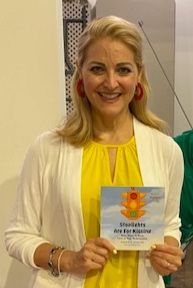
Author/CEO/Metalsmith/Stepmom
Arts Involvement Bio - Daneker
Bonnie Daneker founded The Author’s Greenhouse to help writers achieve the dream of publishing. Within her 20+ years of experience, she is also the author/co- author of multiple
books including The Compassionate Caregiver Series®; CLIMB: Leading Women in Technology Share Their Journeys to Success; It's In There, The Story of Prego Spaghetti Sauce; Publishing as a Marketing Strategy; and Building a Business, Building a Life. Most recently she wrote and published the Stoplights Book Series® to add more love in your life.
Bonnie earned her MBA in Strategic Planning and Entrepreneurship from Goizueta Business School and a BA in Journalism from The Ohio State University. She has guest-lectured at Goizueta and has taught at Savannah College of Art and Design (SCAD). She served on The Ohio State University College of the Arts & Sciences Alumni Society Board of Directors and as President, National Association of Women Business Owners (NAWBO)– Atlanta Chapter. Prior to her work in publishing, she worked in technology and marketing.
Early in her career, she worked as a marketing coordinator for the New York State Council on the Arts (NYSCA), supporting development efforts and grant allocations. At Ohio State, she worked as a
staff writer to promote events of the College of the Arts
and its artistic partners (Columbus Symphony Orchestra
and The Ohio Theatre among others). There, she wrote copy for student recruiting materials for the visual and performing arts programs.
Bonnie Daneker and her husban… Read More